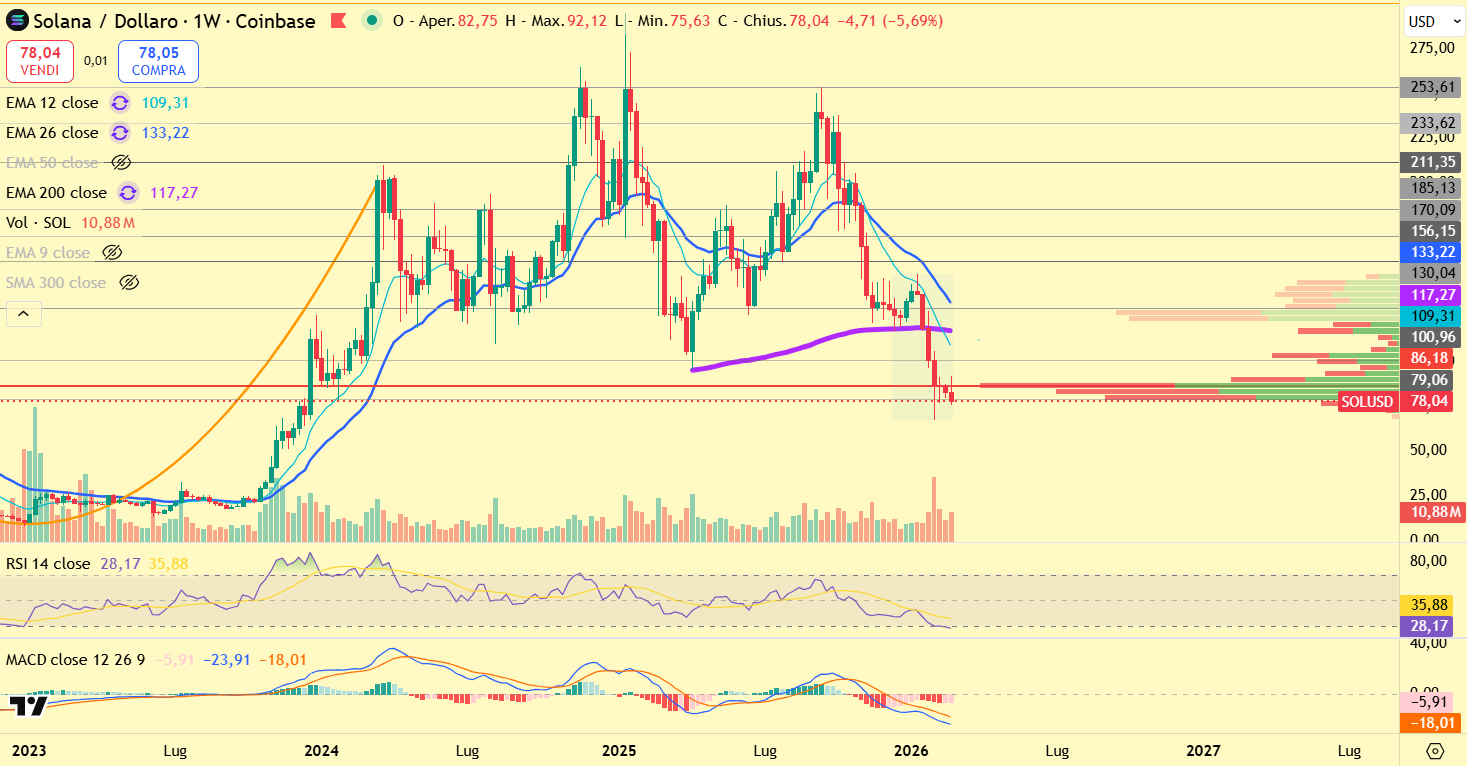


The current Ethereum market outlook reflects one of the most delicate phases of the cycle since the transition to proof of stake. After months of compressed volatility and repeated failures to reclaim higher price levels, Ethereum is now trading within a zone where technical structure, on chain behavior, and macro conditions intersect in a critical way. This is no longer a question of short term noise. The market is testing whether Ethereum can stabilize its role as the backbone of decentralized finance and institutional crypto infrastructure under tightening conditions.
Ethereum has entered a phase where price weakness is visible, yet underlying metrics paint a more complex picture. This divergence between market structure and network fundamentals is the central theme defining the current Ethereum market outlook.
Market Structure and Price Behavior
From a structural perspective, Ethereum has confirmed a sequence of lower highs and lower lows on higher timeframes. Attempts to recover above major resistance zones have consistently failed, signaling that sellers remain in control of directional momentum. The loss of previously defended trend structures has shifted the technical bias toward caution.
The price is now oscillating near historically relevant demand areas. These zones acted as accumulation regions in prior cycles and therefore carry both technical and psychological importance. A sustained failure to hold this area would expose Ethereum to deeper retracements, while stabilization could form the basis for a medium term base.
What makes the Ethereum market outlook particularly complex is that these technical signals are unfolding while several long term fundamentals remain intact. This creates a scenario where downside risk exists, but is not necessarily accompanied by structural network deterioration.
Liquidity Conditions and Derivatives Pressure
Liquidity conditions remain uneven across spot and derivatives markets. While trading volumes are elevated compared to local lows, they remain below levels typically associated with trend reversals. This suggests that participation is selective rather than broad based.
In derivatives markets, leverage has been progressively reduced following recent drawdowns. This deleveraging process often precedes either a period of consolidation or a sharp directional move once positioning resets. The absence of excessive leverage reduces the probability of cascading liquidations, but also limits upside acceleration in the short term.
From a market structure standpoint, this environment favors range expansion only after a clear catalyst emerges. Until then, the Ethereum market outlook remains constrained within defined technical boundaries.
Exchange Supply and Holder Behavior
One of the most notable elements shaping the Ethereum market outlook is the behavior of supply across centralized venues. Ethereum balances held on exchanges are near multi year lows. This indicates that a growing portion of supply is being held off exchange, typically associated with longer term holding behavior.
This trend reduces immediate sell side liquidity and can act as a stabilizing force during periods of stress. However, low exchange supply alone does not guarantee price appreciation. Demand must eventually meet this reduced availability for price to respond.
At the same time, large holders have shown mixed behavior. While some long term holders continue to accumulate or maintain exposure, others have distributed into rallies, adding overhead pressure. This distribution pattern explains why rebounds have struggled to sustain momentum.
Ethereum Within the Broader Market Context
The Ethereum market outlook cannot be analyzed in isolation. Ethereum remains tightly linked to broader crypto market dynamics and global risk sentiment. When risk appetite contracts, capital tends to concentrate in the most liquid assets, often favoring Bitcoin over alternative networks.
This rotation effect has been visible in recent months. Ethereum has underperformed during periods of macro uncertainty, even as network activity remains robust. This highlights a key structural challenge. Ethereum’s utility does not automatically translate into price strength during risk off regimes.
However, this relationship can reverse when conditions stabilize. Historically, Ethereum has outperformed during phases where capital moves down the risk curve after Bitcoin consolidates.
Network Fundamentals and Structural Strength
Despite price weakness, Ethereum’s network fundamentals remain structurally strong. The ecosystem continues to host the majority of decentralized finance liquidity, tokenized assets, and smart contract activity. Layer two adoption has increased throughput and reduced congestion, improving user experience without compromising base layer security.
Staking participation remains high, reinforcing network security and reducing circulating supply. This staking dynamic is a long term structural pillar of the Ethereum market outlook, as it aligns economic incentives with network stability.
Importantly, Ethereum’s role as settlement infrastructure extends beyond speculative use cases. Institutional experimentation with tokenization, stablecoins, and on chain settlement continues to rely heavily on Ethereum and its scaling environment.
Scenario One: Controlled Stabilization and Structural Base
In the first forward scenario, Ethereum successfully defends current demand zones and enters a phase of controlled stabilization. In this case, price action would remain range bound for an extended period, allowing market structure to reset without further aggressive downside.
This scenario would likely involve:
- Gradual absorption of sell pressure
- Continued reduction of exchange supply
- Neutralization of bearish momentum indicators
- Sideways consolidation below major resistance
Over time, this base could support a structural recovery once macro conditions improve. A reclaim of higher resistance zones would signal a shift in the Ethereum market outlook from defensive to constructive.
Under this scenario, upside expansion would not be immediate. Instead, it would unfold through higher lows and compression, setting the stage for a larger breakout later in the cycle.
Scenario Two: Deeper Structural Retracement
In a more adverse scenario, Ethereum fails to hold current support and enters a deeper retracement phase. This outcome would likely be driven by renewed macro stress, further risk off flows, or a breakdown in broader crypto market confidence.
In this case, Ethereum could revisit lower historical demand zones that previously marked cycle transitions. While such a move would be painful in the short term, it would not necessarily invalidate the long term Ethereum market outlook.
Historically, deep retracements during transitional phases have preceded strong multi year expansions. The key variable would be whether network fundamentals remain intact during the drawdown.
This scenario would favor capital preservation strategies and selective accumulation rather than aggressive positioning.
Scenario Three: Structural Repricing and Recovery
The most constructive scenario involves a structural repricing driven by a combination of macro relief, renewed institutional interest, and confirmation of Ethereum’s role as financial infrastructure.
In this case, Ethereum would reclaim key resistance levels and invalidate the current bearish structure. Momentum would attract sidelined capital, derivatives positioning would rebuild, and price could accelerate into higher value zones.
This outcome requires confirmation across multiple dimensions:
- Improved global liquidity conditions
- Stabilization in interest rate expectations
- Positive sentiment shift across digital assets
- Sustained demand for Ethereum based applications
While this scenario is not the base case in the immediate term, it remains a plausible medium term outcome within the Ethereum market outlook.
Key Levels to Monitor
From a structural perspective, several levels define the current Ethereum market outlook.
Immediate resistance remains in the upper consolidation range where prior rejections occurred. A sustained move above this area would indicate a meaningful shift in control.
On the downside, the current demand zone represents a critical inflection point. A clean break below would open the path toward deeper structural supports.
These levels should be monitored not in isolation, but in conjunction with volume, momentum, and broader market behavior.
Strategic Interpretation
Ethereum is currently priced in a zone of uncertainty rather than collapse. The market is weighing near term pressure against long term relevance. This tension defines the present Ethereum market outlook.
For long term participants, this phase is less about precise timing and more about understanding structural risk and opportunity. Ethereum’s network strength suggests durability, but price discovery must still resolve macro and liquidity constraints.
As with previous cycles, the most decisive moves are likely to occur when consensus is least prepared.