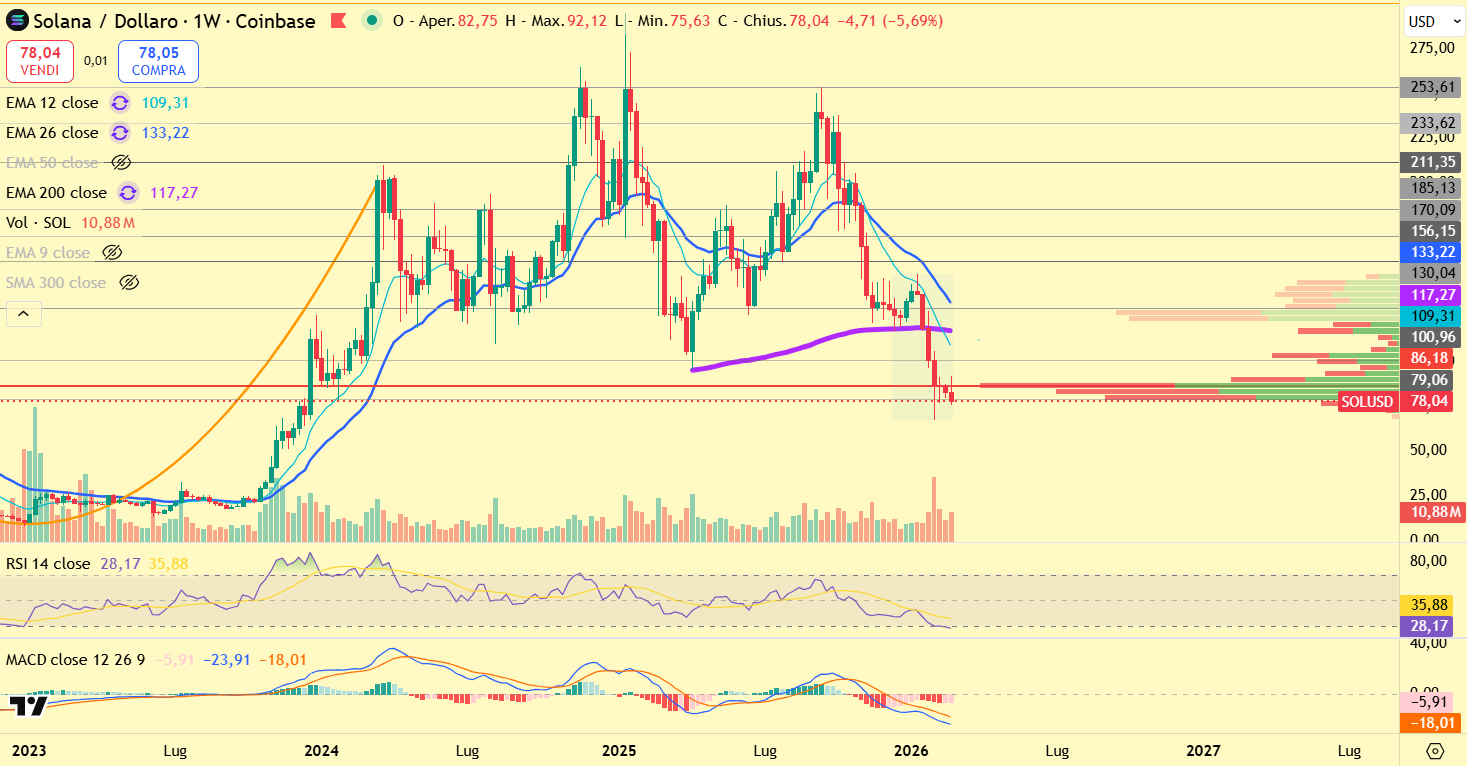
The Bitcoin cycle bottom outlook has shifted meaningfully over recent weeks, and the latest rebound above 76000 dollars has done little to alter the broader structural picture. While short term price action suggests temporary stabilization, a growing body of technical, macro, and flow based evidence indicates that Bitcoin may still be navigating a deeper reset phase within its market cycle.
Bitcoin’s recovery from sub 74000 levels toward the mid 76000 area has been interpreted by some as a relief bounce following aggressive forced selling. However, beneath the surface, market structure continues to deteriorate. Analysts are increasingly converging on the view that the current drawdown may not yet represent the true cycle bottom.
Why the Bitcoin cycle bottom outlook is changing
The Bitcoin cycle bottom outlook is not driven by price alone. It is shaped by the interaction between long term trend indicators, investor positioning, leverage dynamics, and narrative exhaustion.
One of the most significant technical developments in recent weeks has been Bitcoin’s loss of the 100 week moving average. Historically, this level has acted as a critical regime divider between bull and bear market conditions. Bitcoin’s reclaim of this moving average in late 2023 marked the confirmation of the previous bullish phase. Losing it again now suggests a transition into a different structural environment.
From a cycle perspective, this type of breakdown tends to occur not at the end of a correction, but during the early to mid stages of a broader bear phase. This is one of the reasons why several analysts have revised their Bitcoin cycle bottom outlook materially lower.
Weekly structure and trend deterioration
Weekly chart structure continues to weaken despite short term rebounds. The break below the 100 week moving average was not marginal or gradual. It occurred with momentum and follow through, suggesting distribution rather than temporary volatility.
Adding to this picture is the appearance of a long term death cross configuration, where shorter term moving averages roll over beneath longer term trend lines. While death crosses are often dismissed in isolation, their reliability increases significantly when they occur after extended distribution phases and alongside macro tightening.
This combination mirrors previous cycle transitions, most notably the 2021 to 2022 downturn, where early relief rallies failed to reverse structural damage before deeper downside unfolded.
For deeper technical context on long term Bitcoin structure, see https://block2learn.com/category/chart-analysis/.
Why rebounds do not invalidate the cycle thesis
Short term rebounds are a normal feature of bear market dynamics. They relieve oversold conditions, reset funding rates, and temporarily stabilize sentiment. However, they do not, on their own, redefine the Bitcoin cycle bottom outlook.
In past cycles, some of the strongest rallies occurred well before the true bottom formed. These moves often created false confidence, only to be followed by renewed downside once liquidity conditions tightened again.
The recent bounce above 76000 fits this historical pattern. It reflects short covering and tactical buying rather than a broad based return of long term demand.
The role of leverage and cost basis stress
One of the underappreciated drivers of the current Bitcoin cycle bottom outlook is cost basis stress among large leveraged holders. Bitcoin’s move below key institutional and corporate entry levels introduces new psychological and mechanical risks.
Several large positions were accumulated using leverage or structured financing. When Bitcoin trades below these average entry prices, the incentive to defend positions weakens, while the risk of forced adjustments increases.
This dynamic can lead to a slow bleed rather than a single capitulation event. Instead of a sharp crash, the market experiences prolonged downside pressure punctuated by volatile rebounds.
ETF flows and demand exhaustion
Another key input into the Bitcoin cycle bottom outlook comes from traditional finance flows. Spot Bitcoin ETFs were expected to act as a stabilizing force, absorbing volatility and providing structural demand. However, recent data suggests that this demand has weakened.
Spot Bitcoin ETFs have recorded multiple consecutive months of net outflows, signaling a loss of momentum among traditional investors. This is particularly notable given that access to these products has only recently expanded among US wealth managers.
Rather than accelerating inflows, broader access has coincided with fading interest. This suggests that the current narrative may no longer be sufficient to attract incremental capital at higher price levels.
For ongoing analysis of ETF behavior and institutional flows, see https://block2learn.com/category/bitcoin/.
Narrative fatigue and the search for a new catalyst
Every Bitcoin cycle is ultimately driven by narrative. Whether it is digital gold, institutional adoption, monetary debasement, or technological evolution, sustained bull markets require a compelling and timely story.
At present, the dominant narratives appear fatigued. ETF approval has already occurred. Halving effects are well understood and largely priced. Macro conditions remain restrictive rather than supportive.
This narrative exhaustion feeds directly into the Bitcoin cycle bottom outlook. Without a new catalyst, markets tend to drift lower until price itself becomes the narrative.
This is not a failure of Bitcoin’s long term thesis, but a reflection of cyclical capital behavior.
Macro pressure and opportunity cost
Macro conditions continue to act as a headwind. Higher real yields, reduced liquidity growth, and stronger competition from yield bearing assets all increase opportunity cost.
In such an environment, non yielding assets face higher scrutiny. Bitcoin’s value proposition remains intact over the long term, but capital allocators operate within shorter time horizons.
As long as macro pressure persists, the Bitcoin cycle bottom outlook remains vulnerable to further downside, particularly if global risk sentiment deteriorates.
For broader macro context, see https://block2learn.com/category/macroeconomics/.
Why deeper levels are being discussed
Projections placing a potential bottom in the 54000 to 44000 range are not arbitrary. They reflect a convergence of technical retracement zones, historical cycle behavior, and cost basis clustering.
These levels align with previous consolidation zones and represent areas where long term holders may be more willing to accumulate aggressively. Importantly, they also correspond to regions where leverage would be largely flushed from the system.
Reaching such levels would likely be accompanied by extreme pessimism, reduced volume, and widespread disengagement, conditions that have historically marked durable cycle bottoms.
Fear driven narratives and reflexivity
Markets are reflexive. Price declines generate fear, which in turn reinforces selling pressure. External narratives, regardless of their factual basis, can amplify this effect.
When sentiment is already fragile, even peripheral stories can act as catalysts for emotional selling. This does not require fundamental deterioration, only psychological vulnerability.
This reflexivity is a key reason why the Bitcoin cycle bottom outlook must account for sentiment dynamics, not just on chain metrics or macro indicators.
What would invalidate the bearish cycle thesis
Despite the growing consensus around a deeper reset, the Bitcoin cycle bottom outlook is not fixed. Certain developments could materially alter the trajectory.
A sustained reclaim of the 100 week moving average, accompanied by renewed ETF inflows and improving macro liquidity, would challenge the bearish framework. Similarly, the emergence of a new dominant narrative capable of attracting fresh capital could shorten the reset phase.
Until such signals appear, however, the market remains structurally fragile.
Final perspective
Bitcoin’s rebound above 76000 offers temporary relief, but it does not resolve the deeper structural issues shaping the current cycle. The loss of critical long term support, weakening institutional demand, leverage related stress, and narrative fatigue all point toward a prolonged reset phase.
The Bitcoin cycle bottom outlook is increasingly framed not as a question of if further downside occurs, but how it unfolds and where it ultimately stabilizes.
For disciplined investors, this phase is less about prediction and more about preparation. Cycles end not when fear appears, but when fear is fully exhausted.
External market coverage and analyst commentary referenced in this discussion can be found at https://www.coindesk.com/.