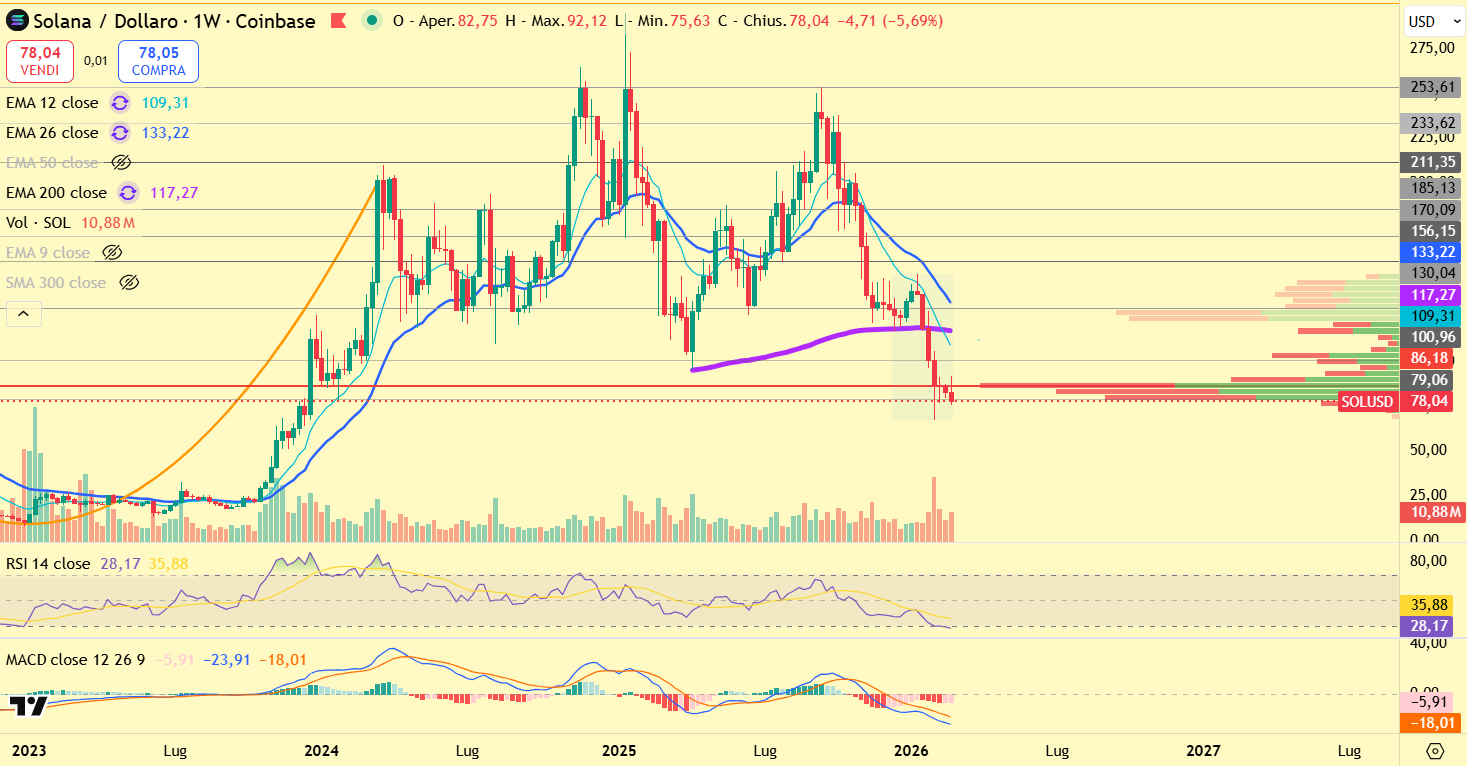


The recent collapse in Solana price action has pushed the market into one of its most stressed configurations of the past year. Heavy liquidation, extreme fear, and sharp volatility have driven price far below prior ranges, forcing both long term holders and short term traders to reassess positioning.
While panic selling has clearly dominated the tape, the current structure also carries the early fingerprints of a short term reflex bounce. That does not imply a trend reversal. It signals a transition from one directional liquidation toward a more complex phase where exhaustion, short covering, and tactical mean reversion can temporarily coexist with a still bearish macro backdrop.
This analysis focuses on Solana price capitulation, separating structural damage from short term opportunity, and clarifying what the current market regime actually allows and what it does not.
Solana price capitulation and market regime shift
The defining feature of the current move is not just price decline, but the manner in which it unfolded. Solana price did not grind lower through orderly distribution. It fell rapidly, accompanied by expanding volume, widening ranges, and correlated selling across the broader crypto market.
Such behavior is typical of forced deleveraging rather than discretionary selling. Risk reduction dominated flows, with participants exiting exposure regardless of valuation or longer term conviction. This is a critical distinction. In forced selling environments, price often overshoots fair value to the downside before stabilizing.
From a regime perspective, Solana price capitulation marks the transition from trend participation to trend unwinding. Once this phase begins, the market dynamics change. Momentum remains bearish, but marginal selling pressure gradually weakens as positions are flushed and liquidity resets.
Daily structure shows trend damage, not stabilization
On the daily time frame, the picture remains unambiguously bearish. Price is trading well below all major exponential moving averages, confirming that the prior uptrend has been structurally broken.
In healthy corrections, assets often find support near short or medium term averages. In this case, Solana price is deeply disconnected from those reference points. That distance reflects not just weakness, but urgency. Sellers were not waiting for levels; they were exiting exposure.
Momentum indicators on the daily chart reinforce this interpretation. Oversold readings are extreme, but momentum remains pointed down. Historically, this combination appears late in selloffs, not at their beginning. It suggests downside reward is compressing, even if downside risk is not yet eliminated.
This is why Solana price capitulation is best described as a late stage liquidation environment rather than an early bear market breakdown.
Oversold does not mean bottom, but it changes probabilities
One of the most common analytical mistakes in stressed markets is equating oversold conditions with an imminent bottom. In strong downtrends, assets can remain oversold longer than expected.
However, oversold conditions do matter for probability distribution. They do not guarantee upside, but they reduce the marginal benefit of chasing price lower while increasing the probability of sharp countertrend moves.
In the current Solana setup, daily momentum is still negative, yet intraday selling pressure is no longer accelerating. That divergence is often the first ingredient required for a reflex bounce, even if the broader structure remains damaged.
Intraday stabilization reflects exhaustion, not recovery
Zooming into lower time frames, the narrative shifts subtly. While the higher time frames define the trend, intraday charts reveal the behavior of marginal participants.
On hourly and lower time frames, Solana price has transitioned from impulsive selling into more balanced two way trade. Volatility remains elevated, but ranges are narrowing. Momentum indicators have lifted from extreme lows into neutral territory.
This does not signal renewed accumulation. It reflects exhaustion. Sellers who needed to sell have largely done so, while new sellers are less aggressive at current prices.
This intraday stabilization is a hallmark of Solana price capitulation phases. It often precedes short covering rallies driven not by bullish conviction, but by positioning repair.
The anatomy of a reflex bounce
A reflex bounce is not a trend reversal. It is a mechanical response to stretched conditions. Understanding this distinction is critical for risk management.
In the current configuration, a bounce would likely be fueled by three forces. First, short sellers locking in profits as downside momentum slows. Second, mean reversion strategies probing value after extreme deviation from averages. Third, broader market relief if correlated assets pause their decline.
Such moves can be violent and emotionally convincing. They often retrace a meaningful portion of the decline, even inside a bearish regime. However, unless price reclaims and holds key structural levels, these rallies remain countertrend.
Within Solana price capitulation, the risk is not missing the bounce. The risk is mislabeling the bounce as recovery.
Resistance overhead remains heavy
One of the defining characteristics of broken trends is the creation of overhead supply. Participants who failed to exit earlier often use rebounds to reduce exposure.
As a result, any rally is likely to encounter resistance well before prior highs. Short term resistance zones tend to align with intraday moving averages and former consolidation areas, while higher resistance clusters sit near daily trend indicators.
Until Solana price can reclaim and sustain levels above those zones, the macro bias remains bearish. Rallies into resistance should be viewed as tests of supply, not confirmations of strength.
Downside risk has not vanished
While downside momentum has slowed, it has not disappeared. If broader market stress resumes, or if liquidity conditions worsen, another leg lower remains possible.
In capitulation environments, markets often form complex bases rather than clean V shaped reversals. These bases involve sharp swings in both directions, designed to shake out weak positioning before any sustainable trend can emerge.
A failure of intraday support zones combined with renewed volume expansion would signal that the liquidation phase is not complete. That outcome would invalidate short term stabilization narratives and reopen downside risk.
Macro context amplifies volatility
The broader crypto market context cannot be ignored. Total market capitalization has experienced sharp contraction, while dominance metrics show capital rotating toward perceived safety rather than risk.
This macro backdrop reinforces the idea that Solana price capitulation is part of a systemic risk off event, not an isolated technical failure. In such environments, asset specific fundamentals play a secondary role to liquidity and positioning.
For market wide data on capitalization and dominance trends, CoinMarketCap provides real time reference points: https://coinmarketcap.com
How to frame positioning in a capitulation regime
Capitulation regimes punish rigidity. Trend followers who enter too late face diminishing reward, while mean reversion traders who overstay bounces are exposed to renewed selling.
The key variable is time frame alignment. On higher time frames, Solana price remains in a broken structure. On lower time frames, stabilization creates tactical opportunity, not strategic clarity.
Participants must decide which horizon they are operating on. Mixing time frames leads to inconsistent decisions and elevated risk.
Solana price capitulation as a process, not an event
Capitulation is rarely a single candle or session. It is a process of forced exits, liquidity resets, and psychological recalibration. The current phase shows many characteristics of late stage stress, but that does not mean resolution is immediate.
Markets often need time to rebuild trust after such moves. Volatility tends to remain elevated, and narratives shift rapidly as price oscillates.
Understanding Solana price capitulation as a process rather than a moment helps frame expectations realistically. Stability comes not from one bounce, but from repeated tests that fail to break lower.
What would change the outlook
The outlook would materially improve if Solana price can reclaim key daily levels and hold them through multiple sessions. That would signal a transition from reflexive behavior to constructive rebuilding.
Conversely, renewed acceleration lower on expanding volume would confirm that the market has not finished unwinding leverage.
Until one of those outcomes materializes, the dominant framework remains unchanged. The trend is bearish, volatility is elevated, and short term rallies exist inside a fragile structure.
For deeper market structure analysis and regime based frameworks applied to crypto assets, additional research is available on Block2Learn: https://block2learn.com/category/market-trends/
At this stage, clarity does not come from predicting the next move, but from respecting the regime. Solana price capitulation has shifted the game from trend continuation to damage control, where survival, discipline, and time frame alignment matter more than directional conviction.