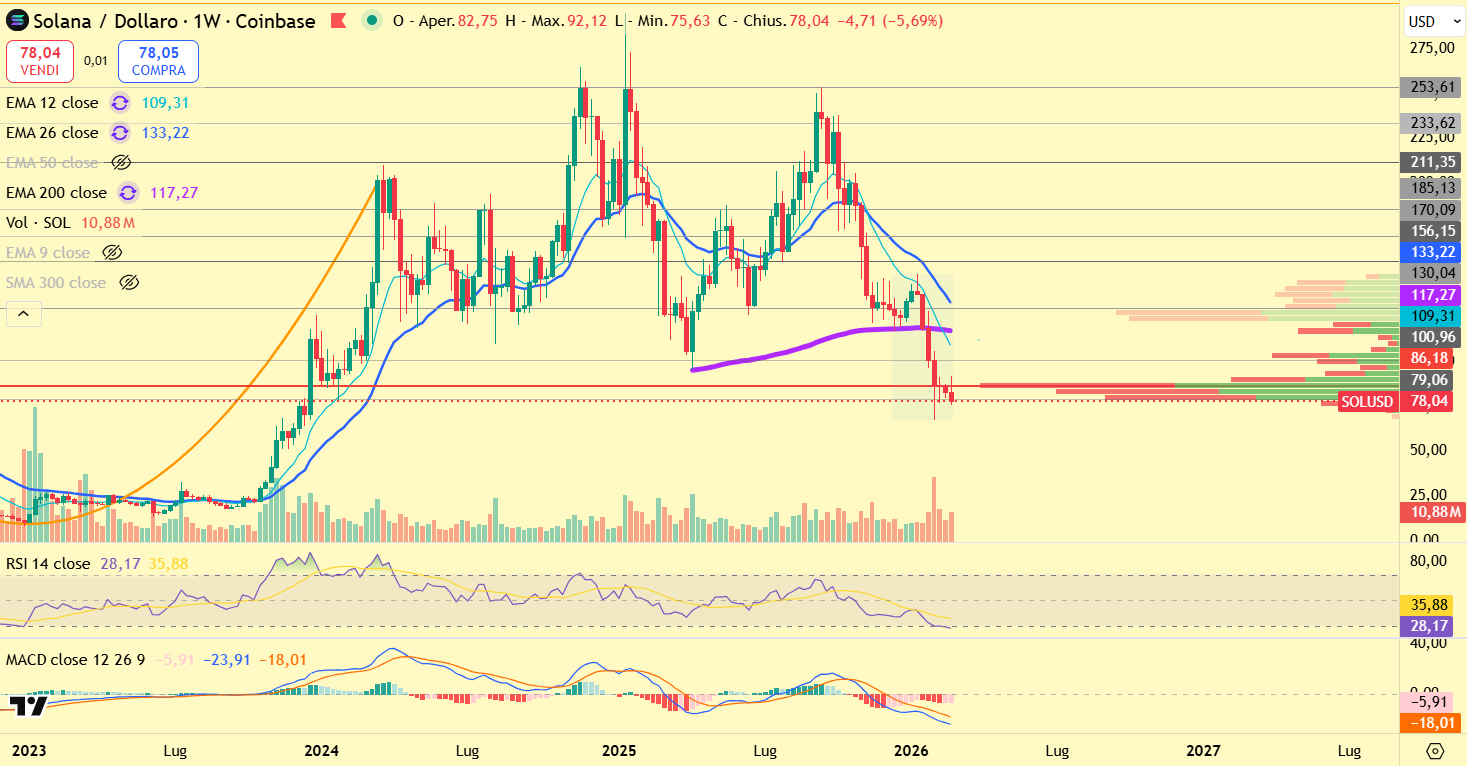
Bitcoin price outlook is no longer shaped only by macro liquidity cycles, ETF flows, or onchain supply dynamics. A new structural variable is entering long term valuation models: quantum computing risk. While once considered theoretical and distant, the possibility of cryptographically relevant quantum machines is now being discussed openly by investors, developers, and institutions.
This shift does not imply an imminent threat to the Bitcoin network. Instead, it reflects a gradual repricing of tail risk. Markets do not wait for certainty. They discount probability. As awareness grows, Bitcoin price outlook is being adjusted to reflect a non zero chance that part of its scarcity narrative could be challenged over the coming decade.
Why quantum risk is entering Bitcoin price outlook models
The core of Bitcoin’s value proposition rests on three pillars: scarcity, immutability, and cryptographic security. Quantum computing introduces uncertainty into the third pillar, which then cascades into the first two.
Current Bitcoin addresses rely on elliptic curve cryptography. A sufficiently powerful quantum computer could theoretically derive private keys from exposed public keys. This would not break Bitcoin overnight, but it would change the risk profile of older coins whose public keys are already visible onchain.
According to several cryptographic research models, this scenario remains low probability in the near term but non negligible over a multi year horizon. Markets price long dated risk differently from immediate threats. This is why Bitcoin price outlook can be affected even without any concrete quantum breakthrough.
For an overview of how long term risk narratives influence crypto valuation, see Block2Learn Market Trends:
https://block2learn.com/category/market-trends/
The role of lost coins in Bitcoin price outlook
A critical element of the quantum debate is the status of so called lost coins. Estimates suggest that roughly 4 million Bitcoin are held in addresses whose private keys are presumed inaccessible. These coins form part of Bitcoin’s effective scarcity narrative and contribute to long term valuation models.
If quantum technology were able to unlock even a portion of these balances, the effective circulating supply would increase materially. From a market perspective, this represents latent supply that could theoretically re enter the system.
Importantly, Bitcoin price outlook does not assume certainty. It incorporates probability. Even a small chance that a supply equivalent to several years of historical accumulation could become spendable introduces a structural discount into long term models.
This does not mean those coins would be sold. It means uncertainty exists around their future status. Markets are highly sensitive to uncertainty when valuing monetary assets.
Governance constraints and why freezing coins is unlikely
One often proposed mitigation is freezing vulnerable coins through protocol changes. In practice, this is far from straightforward. Bitcoin governance is conservative by design, prioritizing immutability and property rights.
Freezing coins would require social consensus around rewriting historical ownership. This would challenge core principles such as fungibility and neutrality. As a result, the probability of such an outcome remains low.
From a Bitcoin price outlook perspective, this reinforces rather than resolves the issue. If governance solutions are uncertain, risk remains unresolved. Markets rarely price best case governance outcomes. They price friction.
For deeper analysis of Bitcoin governance constraints, see Block2Learn Bitcoin section:
https://block2learn.com/category/bitcoin/
Why this matters for Bitcoin versus gold
Bitcoin has historically gained purchasing power relative to gold during expansionary liquidity cycles. This relationship is central to many long term Bitcoin price outlook narratives.
Quantum risk introduces asymmetry into this comparison. Gold does not rely on cryptographic security. Its risk profile is physical, not computational. As a result, some institutions are beginning to treat Bitcoin and gold as complementary rather than directly comparable assets.
This does not invalidate Bitcoin as a store of value. It reframes its risk horizon. Gold carries geological and political risk. Bitcoin carries technological and governance risk. As quantum discussions become mainstream, Bitcoin price outlook relative to gold reflects a wider dispersion of future outcomes.
Institutional portfolio construction increasingly accounts for this divergence rather than assuming linear convergence.
Institutional behavior and long horizon risk pricing
The entry of quantum risk into Bitcoin price outlook is most visible in institutional decision making. Pension style investors and macro funds operate on long duration horizons. They price risks that may materialize many years in the future.
When such investors rotate capital, they do not do so based on headlines. They adjust expected value calculations. Even a low probability adverse scenario can alter allocation sizing if the downside impact is asymmetric.
This does not imply institutional abandonment of Bitcoin. It implies a more nuanced role within diversified portfolios. Bitcoin remains attractive for asymmetric upside and monetary optionality. It is less likely to be treated as a pure digital gold substitute without discounting technological risk.
For broader macro allocation context, see Block2Learn Global Finance:
https://block2learn.com/category/global-finance/
Post quantum migration and realistic timelines
From a technical perspective, Bitcoin has options. Developers and cryptographers emphasize that quantum resilience can be improved through gradual migration to new address formats and cryptographic schemes.
Such transitions would likely unfold over many years rather than through emergency protocol changes. This reduces immediate existential risk but does not eliminate long term uncertainty. Migration introduces coordination challenges and uneven adoption, which markets tend to discount conservatively.
Bitcoin price outlook therefore reflects not only the feasibility of technical solutions but also the complexity of deploying them across a decentralized global network.
For authoritative background on quantum computing timelines, see IBM Quantum research:
https://www.ibm.com/quantum
Market structure implications in the current cycle
The quantum discussion emerges at a time when Bitcoin price outlook is already under pressure due to macro tightening and reduced liquidity. This timing matters.
When markets are strong, tail risks are ignored. When markets are fragile, tail risks are amplified. The current cycle has shifted investor focus from upside narratives to downside resilience.
As a result, quantum risk acts as an additional weight on long term valuation rather than a trigger for immediate selling. It reinforces caution rather than panic.
This explains why Bitcoin can trade significantly below prior peaks without a single dominant catalyst. Multiple structural factors are interacting, and quantum risk is one of them.
What would change the quantum narrative
For quantum risk to fade as a valuation factor, one of two developments would be required.
Either cryptographically relevant quantum machines would be pushed decisively further into the future through technological constraints, or Bitcoin would demonstrate a credible and widely adopted migration path well ahead of any threat window.
Until one of these occurs, Bitcoin price outlook will continue to embed a modest but persistent risk premium. This is not bearish by default. It is the market functioning as designed.
Uncertainty does not destroy value. It reshapes it.
Bitcoin price outlook in a probabilistic world
Bitcoin price outlook is evolving from a simple scarcity narrative into a probabilistic framework. This reflects maturation, not weakness.
As Bitcoin integrates into institutional portfolios and macro models, it is evaluated alongside other long duration assets. Its strengths remain unique. Its risks are becoming better defined.
Quantum computing does not invalidate Bitcoin. It challenges investors to think in longer horizons and wider distributions of outcomes. Markets are not pricing doom. They are pricing complexity.
For investors, the implication is not to react emotionally but to understand regime shifts. Bitcoin remains a high conviction asset for those who accept technological evolution as part of its journey.
More long form analysis and research is available on Block2Learn:
https://block2learn.com/