
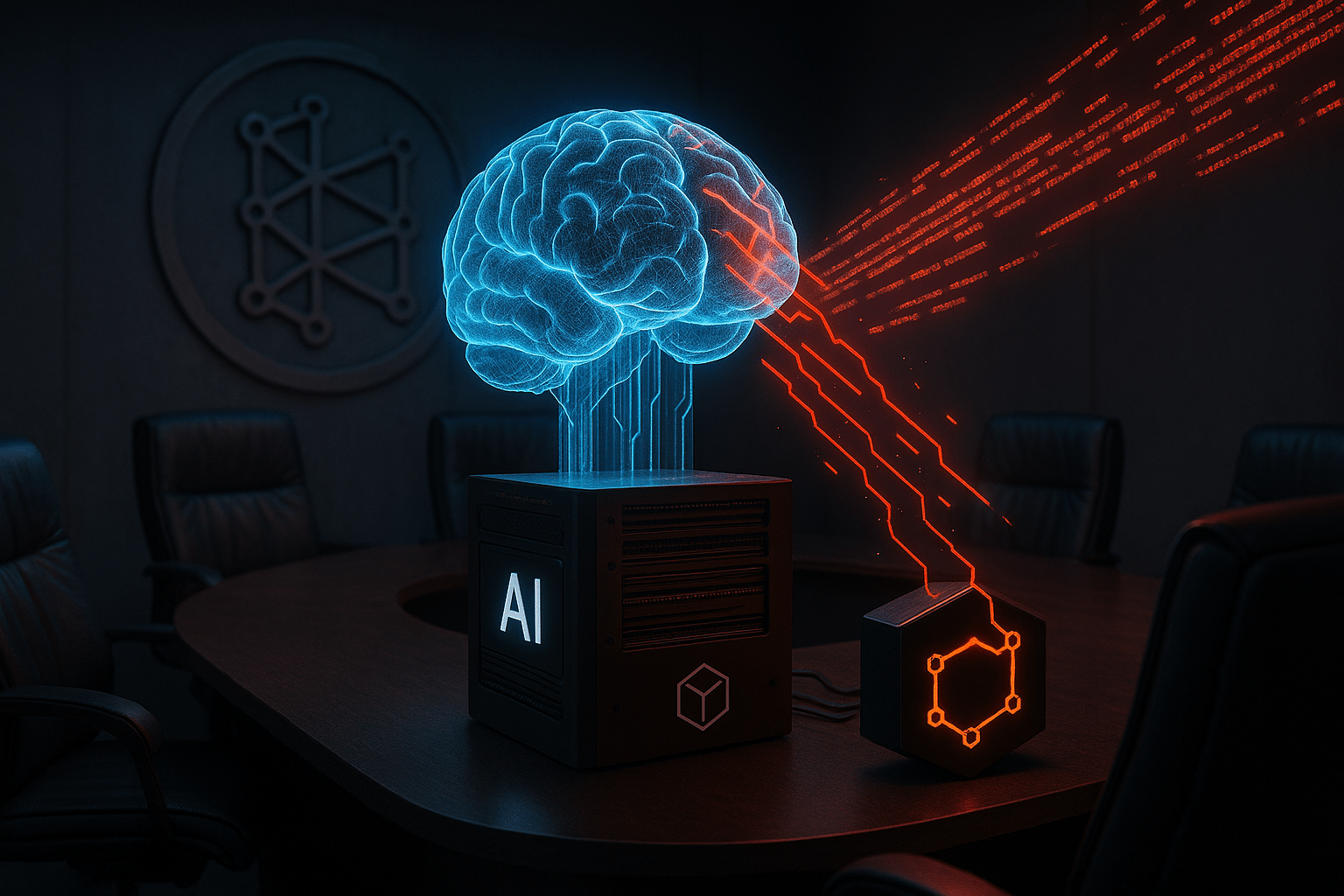
The rapid rise of artificial intelligence has sparked excitement across every industry, from finance to healthcare. In the world of digital assets, developers and governance groups are increasingly exploring whether AI could play a role in managing complex decentralized protocols. Yet the latest debates highlight that AI crypto governance may be far riskier than many realize.
Ethereum co-founder Vitalik Buterin recently warned that relying on AI to make governance decisions or allocate resources opens the door to manipulation. The concern is not that AI lacks intelligence but that it can be tricked in very human ways — through prompts, jailbreaks, or cleverly engineered exploits.
These risks have become more apparent after recent demonstrations showed how AI tools can be hijacked to reveal private information or follow malicious instructions. For decentralized organizations considering automation, the message is clear: without safeguards, AI could destabilize governance rather than strengthen it.
Why AI crypto governance is attractive
The appeal of AI crypto governance is easy to understand. Decentralized autonomous organizations (DAOs) and blockchain protocols require constant decision-making, from approving funding proposals to updating protocol parameters. Human governance can be slow, biased, and vulnerable to voter apathy.
AI offers the promise of faster, data-driven decisions. Advanced models can analyze vast amounts of market, user, and technical data to propose efficient outcomes. For example, an AI system could automatically allocate treasury funds to the most productive contributors, or optimize staking parameters in real time based on market liquidity.
In theory, AI-driven governance could reduce human error, lower costs, and make protocols more adaptive to changing conditions. However, practice reveals deeper problems.
The jailbreak problem
Recent updates to major AI models have introduced new risks. A notable case involved a demonstration where an AI system was tricked into leaking private email data using a carefully designed prompt. This type of “jailbreak” shows that even sophisticated AI models can be manipulated through indirect instructions, sometimes hidden in everyday tasks like calendar invites.
For AI crypto governance, this vulnerability is critical. If an AI agent can be hijacked, malicious actors could redirect funds, approve fraudulent proposals, or destabilize a protocol. In decentralized finance, where billions of dollars are at stake, the cost of a single exploit could be catastrophic.
Alternative approaches to AI integration
Instead of placing AI directly at the center of decision-making, experts suggest creating layered systems where human oversight remains essential. One proposed method is the “info finance” model. Rather than trusting a single AI to decide, multiple participants can submit models or predictions into an open market.
These models are then tested through spot-check mechanisms, with results evaluated by human juries or prediction markets. Such frameworks ensure that no single model has unchecked power. They also create incentives for external parties to monitor AI outputs and quickly flag manipulation attempts.
This approach keeps the benefits of AI — speed, data analysis, automation — while limiting the risks of centralization and manipulation.
For a deeper exploration of decentralized governance models, Block2Learn offers detailed guides and case studies: https://block2learn.com/category/defi/.
Governance and diversity of models
Another weakness of relying on a single AI is the lack of diversity. In human governance, the value of having many participants lies in the range of perspectives. If a DAO replaced human votes with one centralized AI model, that diversity would vanish, replaced by the blind spots of a single system.
By encouraging a competitive environment where different models contribute, governance gains resilience. Model diversity makes it harder for attackers to compromise the system, since no single exploit could dominate the entire process.
Broader implications for security
The risks of AI crypto governance extend beyond DAOs. As AI agents become more deeply integrated into blockchain infrastructure, they may also play roles in portfolio management, market-making, or even consensus mechanisms. If these agents are vulnerable to prompts or phishing-style attacks, entire markets could be destabilized.
For example, an AI managing treasury allocations could be tricked into sending funds to attacker-controlled wallets. Or an AI tasked with monitoring on-chain activity could be misled into ignoring fraudulent transactions. These scenarios are not science fiction — they are realistic threats demonstrated by existing jailbreaks.
Regulatory and ethical concerns
Governments and regulators are also watching the intersection of AI and crypto closely. Financial authorities are already skeptical about decentralized governance, fearing that it lacks accountability. The introduction of AI agents only complicates the picture.
If AI crypto governance leads to large-scale exploits, regulators may impose stricter rules, potentially undermining the decentralization ethos of blockchain. Ethical concerns also arise: who is responsible when an AI agent makes a damaging decision? The developers? The DAO voters? The users who approved its integration?
These questions show that governance is not just a technical challenge but a legal and moral one as well.
Looking ahead
The road forward requires a cautious balance. AI can undoubtedly add value to blockchain ecosystems, but full automation of governance is not realistic today. Instead, hybrid systems — where AI provides analysis, recommendations, and monitoring but final decisions rest with humans — are far more practical.
Prediction markets, info finance models, and multi-layered oversight may all become essential tools in blending AI with governance without losing accountability. The lesson is simple: AI is powerful, but without careful design, it becomes a liability rather than an asset.
Final reflection
The debate over AI crypto governance is ultimately about trust. Blockchain was built to remove reliance on centralized actors, but replacing them with centralized AI models risks recreating the same problem in a different form. Until models can demonstrate resistance to manipulation and transparency in their decision-making, AI should remain a tool — not the authority — in decentralized systems.
For investors, developers, and governance communities, the message is clear: explore AI, but do not outsource critical decisions to it. The future of decentralized finance depends on resilience, diversity, and accountability, values that no single algorithm can yet guarantee.
For more insights into the convergence of blockchain, AI, and decentralized governance, explore Block2Learn’s research: https://block2learn.com/category/artificial-intelligence/.
This article is provided solely for informational and educational purposes and does not constitute financial or investment advice, a recommendation, or an offer or solicitation to buy or sell any financial instrument or digital asset. See our Financial Disclaimer.
This article was generated with the support of AI and reviewed by the Editorial Team. For more information, see our Terms of Service.