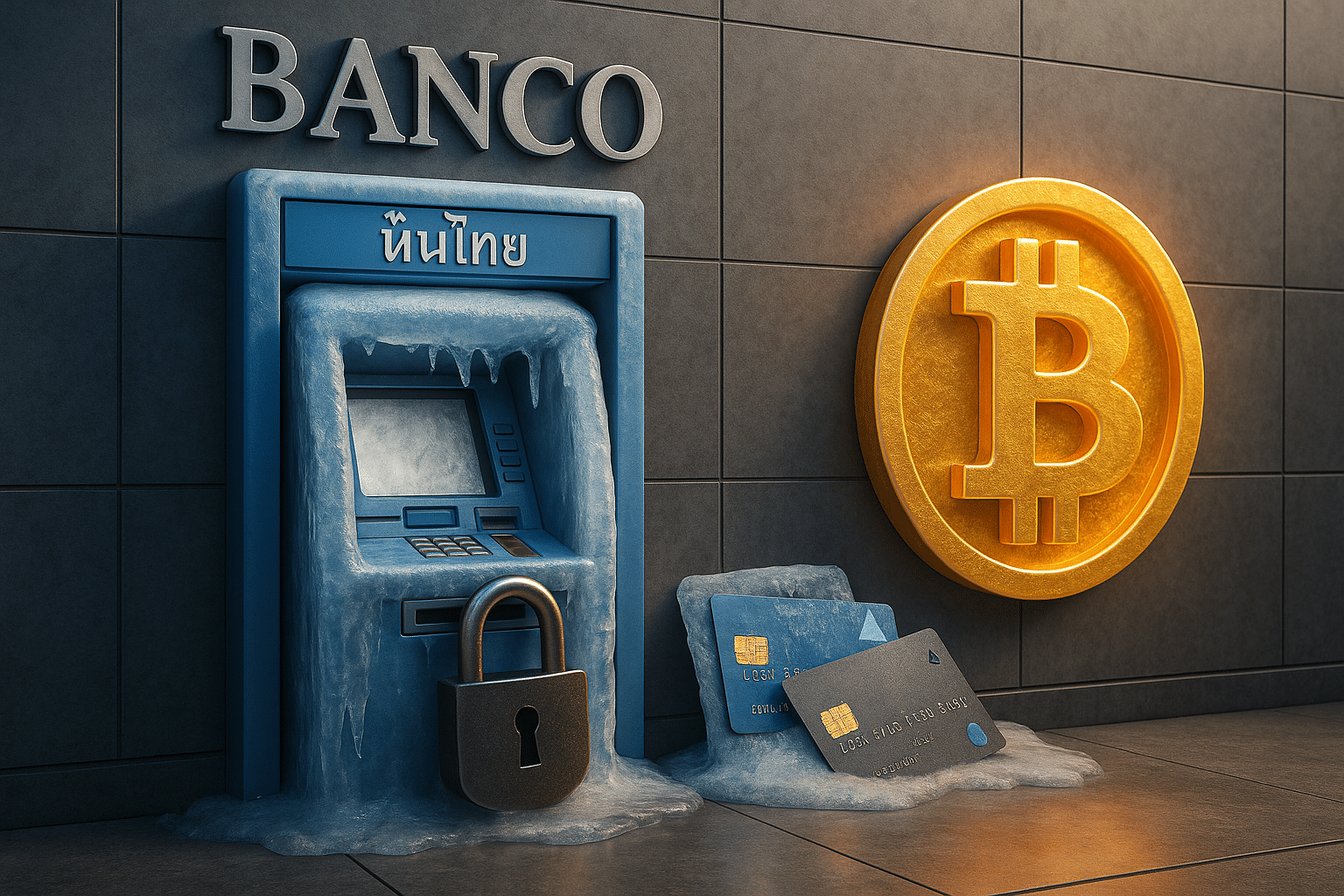
A wave of Thailand frozen bank accounts has thrust millions of citizens and expatriates into financial uncertainty, igniting debates over whether Bitcoin could serve as a safer alternative to centralized banking. In a sweeping anti-scam operation, Thai authorities ordered commercial banks to freeze nearly three million accounts, a move that caught not only fraudulent actors but also innocent individuals and businesses in the crossfire.
The unprecedented crackdown highlights both the vulnerabilities of traditional financial systems and the potential advantages of decentralized alternatives like Bitcoin. While the government defends the actions as temporary and necessary, public trust in the banking sector has been shaken, fueling conversations about the role of digital assets in protecting financial freedom.
A sweeping anti-scam crackdown
The root of the crisis lies in the surge of online scams and fraud syndicates targeting Thai citizens. Many of these schemes are operated by call centers with cross-border connections, particularly from neighboring countries. Criminal groups have been using “mule accounts” — bank accounts controlled by unsuspecting individuals or rented from desperate citizens — to launder stolen money.
In response, Thai banks imposed strict daily transfer limits ranging from $1,300 to $5,500 and froze accounts suspected of involvement. According to the Cyber Crime Investigation Bureau, this dragnet was necessary to combat sophisticated laundering tactics. However, the sweeping measures also affected ordinary merchants, online vendors, and expatriates who suddenly found themselves unable to access their own funds.
For many, the freeze extended beyond the initial three days allowed by banks, as police investigations prolonged the restrictions to a full week or more. The result has been widespread disruption for families, small businesses, and foreigners relying on local banking services.
The impact on citizens and expatriates
The sudden freezing of accounts has left many Thais in precarious positions. Small business owners dependent on daily liquidity to pay suppliers and employees have reported severe disruptions. Merchants relying on QR code payments, a widely adopted system in Thailand, faced losses as customers hesitated to transact amid fear of blocked funds.
Expatriates living in the country have also been hit hard. Many reported arbitrary freezes with little explanation, forcing them to physically visit bank branches to re-register biometrics or undergo extensive Know Your Customer (KYC) checks before resuming transactions. For a community already navigating strict regulations, these new hurdles have heightened frustration and distrust.
The Thailand frozen bank accounts crisis illustrates the fragility of centralized systems when governments adopt heavy-handed measures. Even without wrongdoing, individuals risk losing access to their savings overnight.
Bitcoin enters the debate
The crisis has inevitably reignited debate about Bitcoin. Advocates argue that the decentralized nature of Bitcoin makes it immune to arbitrary freezes by governments or financial institutions. A wallet cannot be locked by decree, and transactions cannot be reversed by centralized authorities.
This perspective has gained traction on social media, with many pointing out that Bitcoin offers a form of financial self-sovereignty unavailable in the current banking framework. For some, the Thailand frozen bank accounts scenario has become a powerful case study in why decentralized assets are not just speculative vehicles but potential lifelines for financial freedom.
Yet challenges remain. While trading and holding cryptocurrencies are legal in Thailand, the central bank has prohibited their use as a means of payment. This restriction means that even if citizens wish to use Bitcoin for everyday transactions, they remain constrained by regulation.
Central bank’s response
Amid mounting criticism, the Bank of Thailand acknowledged the difficulties caused by the crackdown. Officials argued that the measures were temporary and designed to protect citizens from scams. They emphasized that accounts cleared of suspicious activity would be reinstated promptly.
At the same time, the central bank has opened discussions with the Cyber Crime Investigation Bureau on refining the process to reduce harm to innocent account holders. These talks may lead to revised procedures or exemptions for verified users, but no clear solutions have yet been announced.
Broader implications for financial systems
The Thailand frozen bank accounts episode raises broader questions about the balance between security and freedom in financial systems. Governments worldwide are increasingly deploying aggressive tools to combat fraud, money laundering, and cybercrime. While effective in certain cases, these actions risk eroding public trust when innocent individuals are disproportionately affected.
For Bitcoin advocates, the crisis underscores the importance of decentralized networks where users retain control over their funds. Unlike fiat accounts, which can be frozen, Bitcoin transactions are censorship-resistant and globally accessible. This is why many view Bitcoin as a hedge not only against inflation but also against arbitrary financial restrictions.
According to CoinDesk: https://www.coindesk.com, global adoption of Bitcoin often accelerates in regions where traditional banking systems fail to provide stability or fairness. Thailand’s current situation fits this pattern, potentially laying the groundwork for broader crypto adoption in Southeast Asia.
What happens next?
The road ahead will depend on how Thai authorities adjust their strategy. If they manage to fine-tune their approach — distinguishing more effectively between fraudulent and legitimate accounts — confidence may gradually return. However, if heavy-handed freezes continue, public disillusionment could deepen, further driving interest in decentralized alternatives.
For investors and observers, Thailand’s case is a reminder of the risks inherent in centralized control. It also highlights the growing role of Bitcoin and other cryptocurrencies as parallel systems that can provide security and autonomy in uncertain times.
Final reflection
The Thailand frozen bank accounts crisis is not just a local problem; it is a global lesson in the fragility of centralized finance. While the government seeks to protect citizens from scams, the sweeping nature of the crackdown has left millions questioning whether traditional banking can still be trusted.
Bitcoin may not yet be a legal payment option in Thailand, but the principles it represents — decentralization, transparency, and financial sovereignty — are resonating more strongly than ever. In a world where access to money can be cut off overnight, the case for decentralized alternatives is no longer theoretical.
For ongoing analysis of financial trends, blockchain adoption, and global regulatory shifts, visit Block2Learn: https://block2learn.com/category/global-finance/.
This article is provided solely for informational and educational purposes and does not constitute financial or investment advice, a recommendation, or an offer or solicitation to buy or sell any financial instrument or digital asset. See our Financial Disclaimer.
This article was generated with the support of AI and reviewed by the Editorial Team. For more information, see our Terms of Service.