
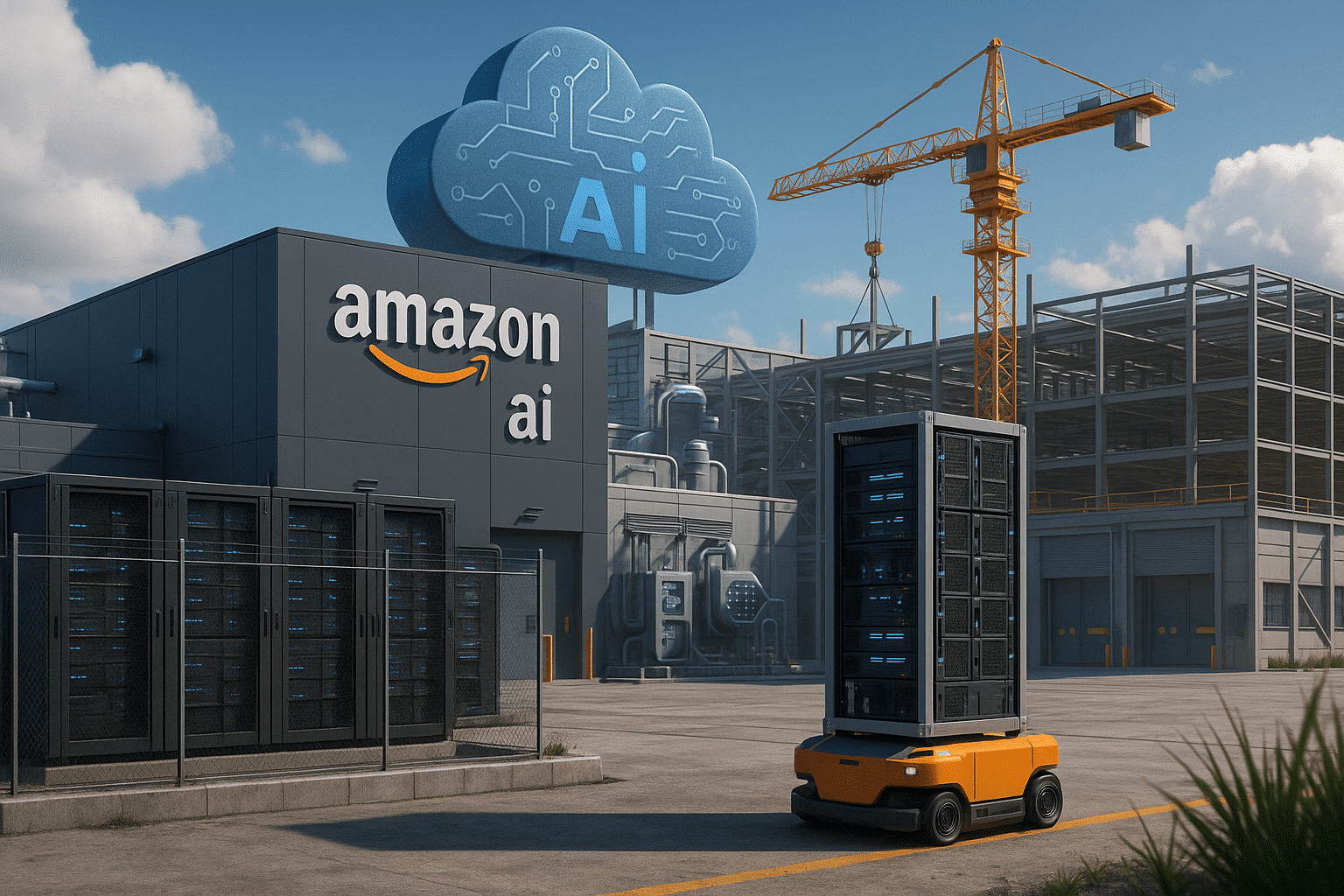
Amazon has made a bold and strategic move with a $10 billion commitment to build data centers in North Carolina, marking one of the largest infrastructure investments in the state’s history. On the surface, this initiative appears to be a massive boost for cloud computing and artificial intelligence development—but a deeper analysis reveals a potential paradigm shift in who controls the future of innovation.
A multibillion-dollar play for AI dominance
The investment aims to establish new, compute-intensive data centers that will support Amazon Web Services (AWS) and its AI-focused workloads. Amazon stated that this project will fuel “the future of AI” and enable businesses to build and scale intelligent applications. Over 500 high-skilled jobs will be created in the process, along with extensive support for STEM education, workforce training, and regional development.
This announcement is not happening in isolation. It comes at a time when Amazon is fiercely competing with Microsoft, Google, and Meta in building out the foundational infrastructure for generative AI, machine learning, and large-scale language models. As AI accelerates across industries, the backbone of innovation increasingly relies on who controls the servers, GPUs, and data.
The centralization dilemma: when growth limits access
While the investment brings substantial economic and technological benefits, it raises a pressing concern: the centralization of AI capabilities. A $10 billion deployment for data centers is not within reach for most startups or academic research institutions. As infrastructure costs soar, only a handful of companies—those with the capital to build and maintain massive compute environments—will be able to train next-generation AI systems.
This growing divide could lead to a concentration of power where innovation is dictated not by the best ideas, but by who can afford the hardware. Smaller companies and independent developers risk being sidelined, unable to match the scale and access of Big Tech giants.
The implications are far-reaching. Innovation could slow as experimentation becomes financially prohibitive for all but the wealthiest actors. More worryingly, ethical frameworks and AI safety standards may end up being defined solely by corporate agendas.
Humanoid robots, Alexa+, and the expanding AI frontier
Amazon’s AI ambitions extend beyond data centers. The company is testing humanoid robots in a newly developed “humanoid park” at its San Francisco campus. These AI-powered machines are designed for advanced navigation and eventual use in delivery tasks—a potential disruption to logistics and last-mile commerce.
Meanwhile, Amazon has begun rolling out Alexa+, a next-generation, generative AI assistant currently available to 100,000 early users. Powered by more contextual and conversational intelligence, Alexa+ signals Amazon’s broader goal: to embed AI into everyday life and cement its ecosystem within homes and workplaces.
These advancements highlight how Amazon is positioning itself as not only a provider of cloud services but also a consumer-facing AI company with integrated hardware, software, and infrastructure layers.
Local benefits versus global implications
In North Carolina, Amazon’s presence will undoubtedly generate economic momentum. Beyond the 500 direct jobs, the initiative includes:
- Technician training programs at community colleges
- STEM funding for K–12 schools
- A $150,000 Community Fund for sustainability and health programs
- Career development in fiber broadband and digital infrastructure
Yet while local communities may benefit from Amazon’s footprint, the long-term global consequences must be examined. If Big Tech consolidates both infrastructure and application layers of AI, we risk creating a bottleneck in innovation that could take years to correct.
The crypto-AI perspective: decentralization as a counterforce
Some voices in the AI infrastructure space, particularly those building on blockchain, see Amazon’s move as validation—but also a wake-up call. The rapid rise in AI deployment costs strengthens the case for decentralized and open-source AI models. Permissionless intelligence, backed by community-owned compute power, may offer a path to broader participation and fairer innovation.
Amazon’s initiative underscores the urgency of building alternative frameworks—ones where access to compute power isn’t dictated by trillion-dollar balance sheets.
A look toward the future
Amazon’s $10 billion gamble in North Carolina is about more than servers and jobs. It’s a signal that AI infrastructure is the new battleground in tech, with control over compute resources becoming as strategic as control over data once was.
This isn’t just about Amazon. It’s about the rules of the next technological era. Will AI be open, collaborative, and accessible—or locked behind corporate firewalls and gated infrastructure?
For now, Amazon is building faster than its competitors, but the race is far from over. As AI transforms society, the real question isn’t who can build the most data centers—it’s who gets to innovate with them.
This article is provided solely for informational and educational purposes and does not constitute financial or investment advice, a recommendation, or an offer or solicitation to buy or sell any financial instrument or digital asset. See our Financial Disclaimer.
This article was generated with the support of AI and reviewed by the Editorial Team. For more information, see our Terms of Service.