


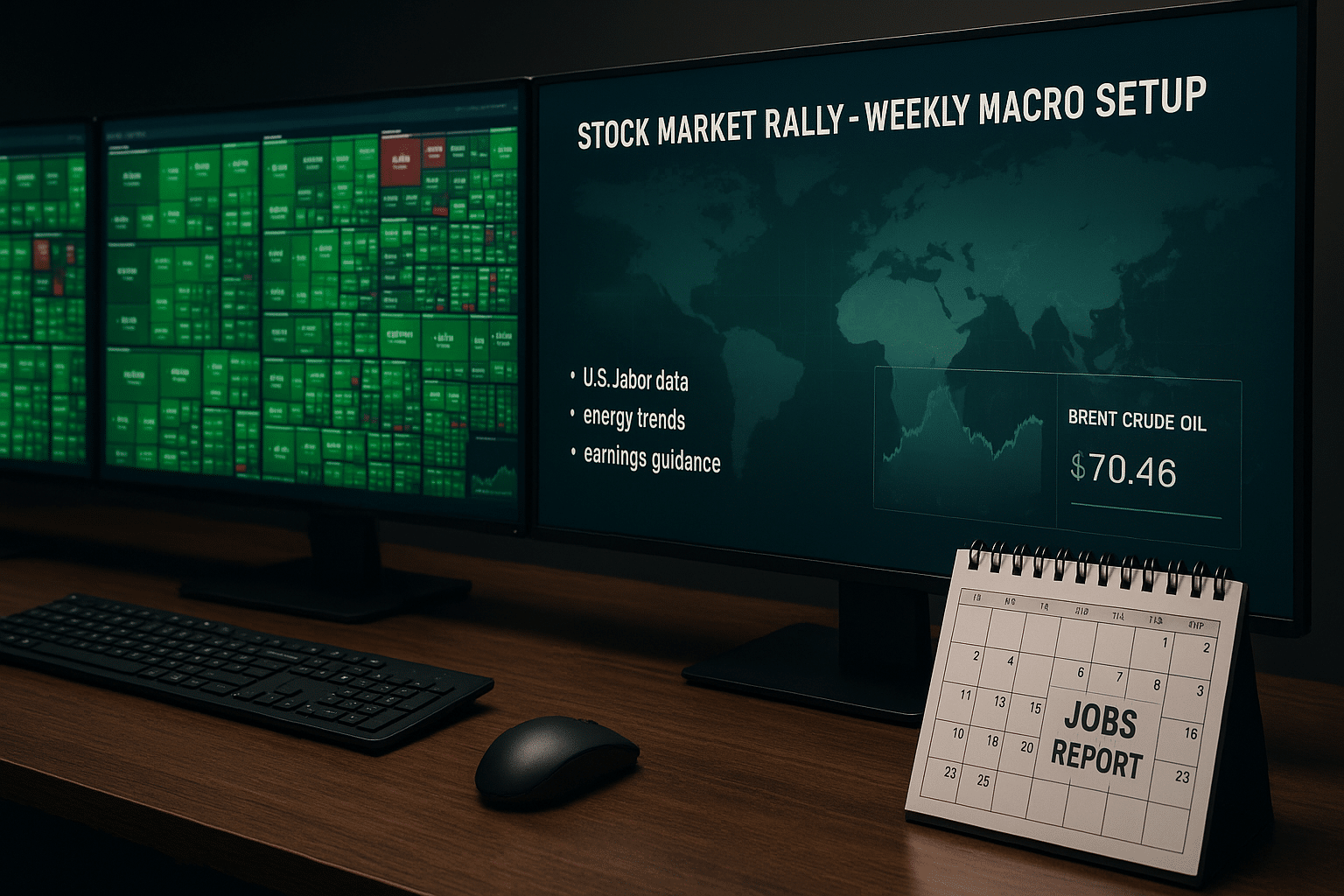
The stock market rally is gathering pace at the start of the week, buoyed by cooler core inflation, resilient consumer outlays, and a broadly constructive tone across Asia and Europe. After three sessions of weakness, U.S. benchmarks turned higher and futures suggest buyers are willing to press the advantage as attention pivots to Friday’s U.S. employment report. Whether the stock market rally can extend will depend on a delicate balance: inflation progress strong enough to keep the Fed comfortable, but labor data not so soft that growth risks resurface.
U.S. macro check: inflation cools, spending holds up
August core PCE—the Federal Reserve’s preferred gauge that strips out food and energy—rose 0.2% month-over-month and 2.9% year-over-year, a step in the right direction for policymakers who want to see inflation glide toward 2%. Source for the series is the U.S. Bureau of Economic Analysis: https://www.bea.gov. At the same time, consumer spending advanced 0.6% in August, reminding markets that household demand remains a counterweight to softer hiring and sentiment. The stock market rally thrives on precisely this mix: moderating inflation alongside still-healthy activity.
Yet the composition of demand matters. Higher-income households continue to spend, while lower- and middle-income cohorts feel the pinch from higher prices for groceries, furniture, autos, and services. The past few months have also seen spending growth outpace income—a gap that cannot widen indefinitely. For investors navigating the stock market rally, that divergence is a key risk to monitor into Q4.
All eyes on Friday’s jobs report
The week’s focal point is the U.S. nonfarm payrolls release. Consensus looks for a pickup in job creation versus August, with unemployment and participation rates in focus. The official source is the U.S. Bureau of Labor Statistics: https://www.bls.gov. Before Friday, markets will parse the ADP employment snapshot and the ISM manufacturing PMI on Wednesday, followed by ISM services on Friday. Information about the ISM surveys is available at the Institute for Supply Management: https://www.ismworld.org. A “goldilocks” combination—steady job gains, easing wage growth, and firm participation—would support the stock market rally by reinforcing a soft-landing narrative. Conversely, a downside surprise in hiring or a jump in average hourly earnings could jolt rate expectations and trim equity enthusiasm.
Another wild card is Washington’s budget brinkmanship. While lawmakers work to avert a federal government shutdown, even short disruptions can muddy data release schedules and dent risk appetite. For now, futures imply the stock market rally expects lawmakers to find a path forward.
Earnings micro: cruise lines, sportswear, and staples in the spotlight
On the corporate front, a trio of updates will offer read-throughs on consumer strength and cost discipline. A leading cruise operator reports Monday, a global sportswear brand on Tuesday, and a packaged-foods company on Wednesday. Though single prints rarely make or break a stock market rally, commentary on bookings, inventories, promotions, and gross margin trends can shift sector leadership quickly. If management teams frame Q4 as demand-positive with manageable discounting, cyclicals and consumer discretionary could extend their bid.
Europe opens firmer; policy and banks in focus
European equities are set to start higher, with DAX futures pointing to modest gains and the FTSE MIB fresh off a 1% rise on Friday. Italy-specific headlines center on the fiscal framework and discussion of potential contributions from large banks ahead of the budget draft (“Documento programmatico di finanza pubblica”). The way fiscal consolidation squares with growth and bank profitability will shape local leadership inside the stock market rally. For broader European context and cross-asset movements, see Block2Learn’s Global Finance section: https://block2learn.com/category/global-finance/.
Geopolitics and security: a background variable for risk
Northern European air-space vigilance remains elevated amid repeated drone incursions. While these events typically have limited direct market impact, any escalation that affects civil aviation or trade corridors can inject volatility, especially into European transport and insurance names. For a stock market rally leaning on calmer volatility, geopolitical noise is best kept to a low simmer.
Energy: OPEC+ supply path and Brent retreat
Brent crude eased roughly 1% toward the high-$60s as participants weighed the next OPEC+ meeting. Signals suggest a modest production add in November—smaller than the previous monthly increments—as the group balances market-share ambitions against price stability. Official information about the alliance and meeting communiqués can be found via OPEC: https://www.opec.org. Cheaper oil, if sustained, would be a tailwind for the stock market rally by tempering headline inflation and easing cost pressure on transportation-heavy industries. The flip side: too sharp a drop could flag demand concerns.
Asia Pacific: firmer tone as China profits stabilize
Asia set a constructive tone overnight. Hong Kong and Seoul led gains as Chinese industrial profits returned to growth after months of declines, hinting at a tentative bottoming in manufacturing margins. The Shanghai Composite edged higher and Indian equities opened firm, while Tokyo lagged as position-squaring clipped exporters. If Asia’s improvement persists, it underwrites the global stock market rally by boosting appetite for cyclicals tied to trade, semiconductors, and industrial automation.
Italy watchlist: luxury, media, and football finance
In single-name Italy stories, a luxury house drew attention after market-surveillance inquiries around short selling activity; transparency and positioning dynamics may keep volatility elevated in the near term. Meanwhile, an Italian media group surfaced in discussions over a potential stake purchase in Portugal, a reminder that media consolidation catalysts can decouple from macro. In sports business, a major football club reported a sharply narrower annual loss thanks to Champions League participation and improved player-trading results, with management reiterating targets into 2026/2027. For equity investors, these micro narratives add texture to the stock market rally, shaping where relative performance emerges.
What could extend—or derail—the rally from here?
Three forces will likely determine the path of the stock market rally through week-end:
- Labor data quality
A steady payrolls print with contained wage growth supports soft-landing odds. A hot wage number risks rekindling inflation concerns; a weak hiring figure risks stoking growth fears. - Energy glidepath
Oil stabilizing in the $60s–$70s would cushion transportation and consumer sectors. A renewed spike would complicate the disinflation narrative driving the stock market rally. - Earnings guidance and margins
If management teams emphasize resilient demand and disciplined promotions into the holidays, multiples can hold. Margin warnings would crimp cyclicals first.
For ongoing macro context and strategy explainers, explore Block2Learn’s Macroeconomics hub: https://block2learn.com/category/macroeconomics/ and Market Trends: https://block2learn.com/category/market-trends/.
Bottom line
The stock market rally is riding a favorable mix of cooling core inflation and sturdier-than-feared spending, with Asia and Europe adding support. The next inflection will come from U.S. labor data and energy dynamics. Investors who want to participate without overreaching can favor quality cyclicals, select consumer names with pricing power, and internationally exposed industrials—while keeping hedges in place ahead of Friday’s print. Momentum is improving, but the market will demand confirmation from jobs, earnings, and oil before declaring a clean break higher.
Start Free Today. Unlock Your 15% Member Discount.
Access the Free Start program immediately and receive an exclusive 15% discount for your first Learning Path purchase.
Build your foundation before making your next investment decision.


