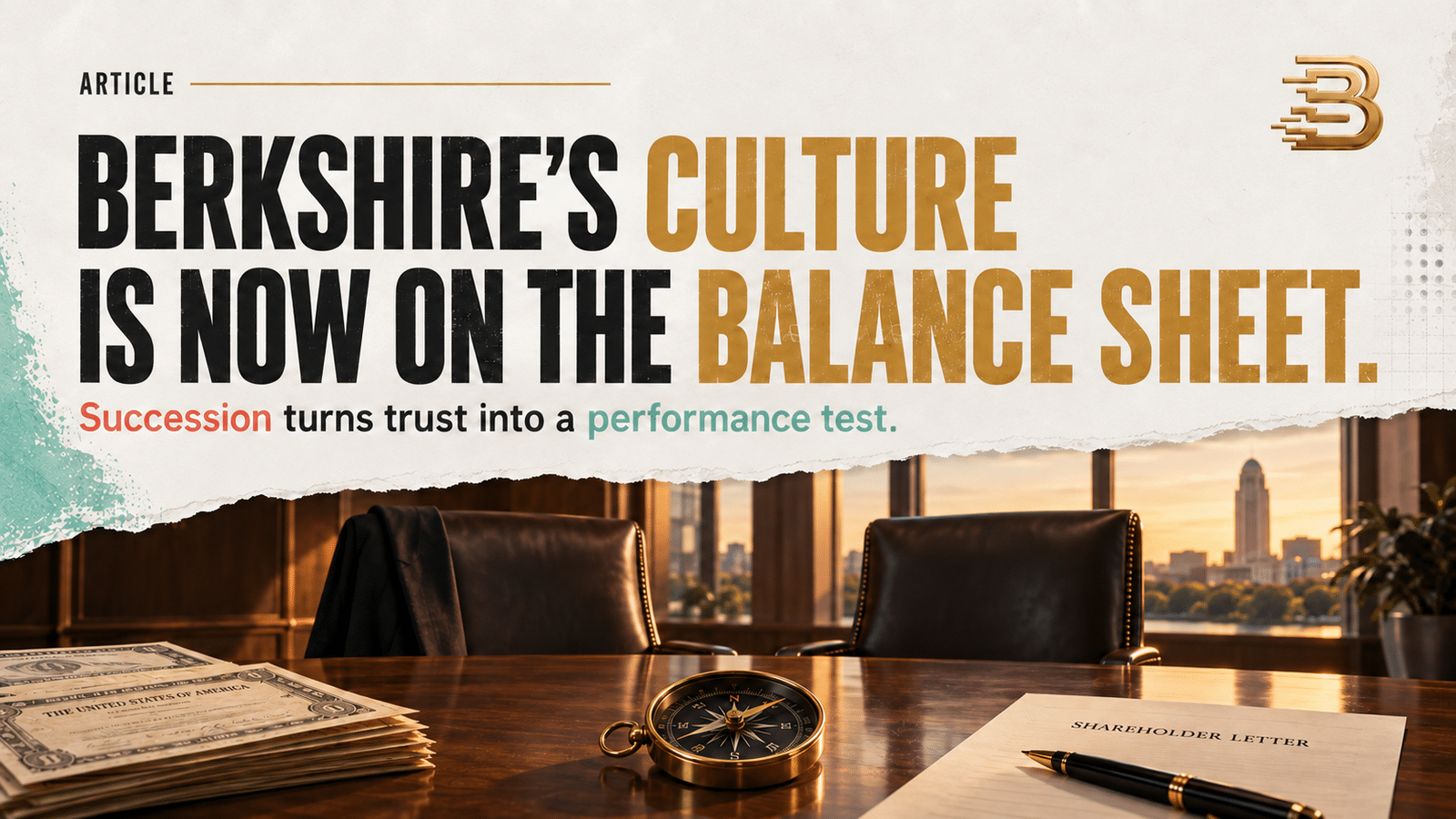
Berkshire Hathaway succession has moved from a distant governance question to an observable valuation test. Warren Buffett stepped down as chairman on September 18, becoming chairman emeritus, while Howard Buffett assumed the chair and Greg Abel continued as chief executive. The formal transfer was expected. The difficult part is not. Investors must now decide how much of Berkshire’s premium belongs to businesses and balance-sheet capacity that can be measured, and how much belongs to a culture that was inseparable from one extraordinary capital allocator for more than six decades.
The market has often treated Berkshire as more than the sum of an insurer, a railroad, a utility group, industrial companies and a large equity portfolio. It has priced the company as a system: decentralized operations, unusually patient shareholders, conservative liquidity, disciplined acquisitions and a reputation that could attract deals unavailable to ordinary conglomerates. Buffett’s departure from the chair does not erase that system. It removes the final ambiguity about whether the system can operate without him holding executive or board leadership.
That makes the succession important beyond Berkshire. It is a real-time experiment in whether governance can preserve an intangible asset without freezing a company in the past. The question is not whether Abel can imitate Buffett. He should not try. The question is whether Berkshire can separate three functions that Buffett combined—capital allocation, operating authority and cultural legitimacy—without creating delay, conflict or a costly layer of bureaucracy.
The Chairmanship Change Completes a Planned Separation of Powers
Reuters reported on September 18 that Buffett’s move was effective immediately, nine months after Abel became CEO at the start of 2026. Howard Buffett, a director since 1993, became chairman. Warren Buffett remains a director and can continue to offer judgment, but the legal and practical center of authority is now clearer: Abel runs the company; Howard chairs the board and protects the institutional character that Berkshire regards as economically valuable.
The distinction matters because chief executive and chairman are different jobs. Abel must allocate capital, evaluate operating performance, approve acquisitions, manage senior appointments and decide when Berkshire’s cash should be invested, retained or returned. Howard Buffett’s role is not to create a competing investment committee. It is to make sure that the board remains aligned with shareholders and that management does not dismantle the incentives that made Berkshire unusual.
The Associated Press described the transition as the final stage of a deliberately sequenced plan. That sequence is an advantage. Abel already had years overseeing non-insurance operations before taking the CEO role. Howard had decades of board experience before becoming chair. The company did not wait for an emergency to discover whether authority could be transferred.
Yet preparation does not eliminate the risk. Warren Buffett functioned as both decision-maker and constitutional authority. A manager who disagreed with him still knew who owned the final call and why the broader system worked. Under the new arrangement, the operating and cultural roles are intentionally separated. That can strengthen checks and accountability, but only if the boundaries remain clear. A chair who intervenes too often could weaken the CEO. A CEO who treats culture as ceremonial could weaken the board’s reason for choosing Howard.
The Buffett Premium Was Never a Single Number
The phrase “Buffett premium” sounds precise, but it bundles several effects. One is confidence in capital allocation. Berkshire could hold a vast amount of cash without investors automatically assuming that management would waste it. Another is access. Sellers sometimes preferred Berkshire because it offered permanence, operating autonomy and a reputation for honoring agreements. A third is resilience. Insurance float, Treasury bills, operating cash flow and minimal dependence on parent-level refinancing gave Berkshire the capacity to act during periods when other buyers were constrained.
A fourth component is shareholder selection. Buffett’s letters and annual meetings attracted owners willing to tolerate inactivity, concentrated investments and lumpy results. That patient ownership base reduced pressure to manufacture quarterly earnings or pursue fashionable transactions. Finally, there was personal judgment: Buffett’s ability to estimate business quality, management character and the opportunity cost of capital.
These components will not move together. Berkshire can preserve conservative liquidity even if investors place less faith in the next large acquisition. It can retain patient shareholders even if the stock’s price-to-book multiple narrows. It can maintain operating autonomy while using more formal performance reviews. The transition should therefore be evaluated as a series of tests, not as a binary question of whether the “premium” survives.
Reuters noted that Berkshire’s price-to-book ratio had already declined from roughly 1.62 when Buffett announced his CEO transition to about 1.53. That does not prove the market has assigned a precise succession discount. Book value is an imperfect denominator for a conglomerate containing insurance assets, regulated utilities, a railroad, wholly owned consumer companies and marketable securities. The move does show that investors are repricing confidence at the margin. Berkshire’s future multiple will depend on whether Abel converts the inherited structure into per-share value rather than merely preserving its scale.
Culture Is an Operating System, Not a Corporate Slogan
Berkshire’s own description of culture is unusually specific. In the company’s latest shareholder letter, Abel calls culture a system for generating long-term performance. The model combines autonomy with accountability: operating managers receive room to run their businesses, while Berkshire expects integrity, candid communication and decisions made from an owner’s perspective. That is not a decorative value statement. It is an alternative to a conventional headquarters filled with approval layers, integration programs and quarterly targets.
Decentralization creates economic benefits when it works. Decisions can be made by managers closer to customers, assets and local risks. Berkshire can own businesses across insurance, rail, energy, manufacturing, retail and services without pretending that one central team possesses superior operating knowledge in every field. The parent company can remain small because it does not reproduce every subsidiary function in Omaha.
It also creates vulnerabilities. Autonomy can hide deteriorating performance or poor conduct if information does not travel upward quickly. A weak manager can destroy value for longer when headquarters is reluctant to intervene. Reputation risk is shared even when operations are not. Berkshire therefore depends on a difficult balance: trust must be real enough to attract exceptional managers, but oversight must be strong enough to distinguish deserved trust from passive tolerance.
Abel has already indicated that the decentralized model will remain while accountability becomes explicit. That is the correct direction. Preserving Berkshire does not mean preserving every manager or every asset. It means preserving the principle that intervention is based on evidence and stewardship rather than a corporate instinct to centralize. Howard Buffett’s most valuable contribution will be to defend that principle while supporting timely action when trust is no longer deserved.
The New Structure Creates a Governance Hedge
Warren Buffett described Howard’s role as an insurance policy that shareholders hope never to claim against. The metaphor is revealing because it frames the chair not as an alternate CEO but as protection against institutional drift. If Abel continues to allocate capital well and maintain Berkshire’s values, the policy remains unused. If future management tries to convert Berkshire into a conventional empire—more bureaucracy, more leverage, more promotional reporting or more short-term targets—the chair has standing to defend the original compact.
The 2026 proxy statement helps define that compact. Berkshire says directors should possess integrity, business judgment, an owner-oriented attitude and a significant personal investment in the company relative to their resources. Those criteria are meant to align the board with long-duration owners, not with the career incentives of professional directors.
Howard’s chairmanship nevertheless creates a legitimate governance question because he is Buffett’s son. Family continuity can protect a founder’s philosophy, but it can also weaken perceived independence if loyalty to tradition overrides economic evidence. Investors should not dismiss that tension. The arrangement works only if Howard’s authority is used to protect process and values rather than to preserve family influence for its own sake.
The test will appear in ordinary decisions before it appears in a crisis. Does the board challenge assumptions behind acquisitions? Does it evaluate managers against long-term economics rather than personality or tenure? Does it communicate bad news plainly? Does it allow Abel to run the company? A governance hedge becomes valuable through credible restraint. Constant intervention would indicate that the structure is not functioning as designed.
Capital Allocation Is Where the Succession Becomes Measurable
Berkshire’s philosophy can sound abstract until capital moves. Abel inherited one of the largest reservoirs of deployable liquidity in corporate history. According to Berkshire’s second-quarter 2026 report, insurance and other businesses held approximately $359.2 billion of cash, cash equivalents and U.S. Treasury bills net of unsettled purchases at June 30. Insurance float was about $177.5 billion, and Berkshire reported a negative average cost of float in the first half because the insurance operations produced pre-tax underwriting profits.
Those figures provide extraordinary optionality, but optionality is not automatically value. Cash earns a return in Treasury bills, protects policyholders and lets Berkshire act without financing conditions. It also creates a large opportunity cost if attractive investments are available and management fails to pursue them. Abel will be judged on the spread between what Berkshire earns by waiting and what it could reasonably earn by owning businesses, securities or its own shares.
The early evidence is active rather than frozen. Berkshire completed its OxyChem acquisition for approximately $9.4 billion in January, completed the Taylor Morrison transaction in July and repurchased about $4.8 billion of its own stock during the first half. Those actions do not settle the succession debate. They show that the company is willing to use multiple channels: acquisitions, public securities, operating investment and buybacks.
Block2Learn previously examined Berkshire’s changing capital-allocation regime through its equity and housing exposure. The chair transition adds a governance layer to that analysis. Investors now need to ask not only where the money goes, but how the decision was reached. A sound process should compare prospective returns across all uses, include the value of liquidity and avoid using acquisition size as a substitute for quality.
Insurance Float Remains the Financial Core
Berkshire is often described as a conglomerate with a stock portfolio, but insurance is the engine that gives the structure unusual financial power. Policyholders pay premiums before claims are settled, creating float that Berkshire can invest. Float is economically valuable when underwriting is at least break-even over time because the company receives investable funds at little or negative cost. It becomes dangerous when premiums are inadequate, reserves are weak or catastrophes reveal hidden concentration.
Succession therefore cannot be evaluated only through public-stock choices or acquisitions. Insurance discipline is central. Ajit Jain’s oversight remains important, but governance must preserve a culture in which volume is never mistaken for profitable underwriting. An insurer can grow quickly by accepting risks at prices that look attractive before claims arrive. The real measure is the combined economic result across the cycle.
The large Treasury position serves several purposes at once. It supports claims-paying capacity, generates income, protects against market stress and gives Abel dry powder. In a world of higher sovereign yields, waiting is less costly than it was during zero-rate years. That strengthens Berkshire’s negotiating position because it does not need to buy simply to escape idle cash.
But higher yields also raise the hurdle rate for acquisitions. If short-term government securities offer meaningful returns with minimal credit risk, a new business must provide a substantially better expected return after considering cyclicality, integration risk and management attention. The broader repricing caused by 5% Treasury yields therefore applies even to Berkshire. Its liquidity is more productive, while mediocre deals become harder to justify.
Decentralization Must Survive Without Becoming an Excuse
A common mistake would be to interpret Berkshire’s culture as a prohibition on change. The company’s portfolio of businesses is not a museum. Consumer behavior, energy systems, insurance technology, rail economics and industrial competition evolve. Managers who were exceptional in one environment may be less effective in another. Capital that once earned superior returns can become trapped in mature or regulated assets.
Abel’s task is to preserve the speed and ownership mindset of decentralization while making performance visible enough to allocate capital rationally. That may require more comparable operating data, clearer return thresholds and earlier intervention in underperforming units. None of those changes necessarily violate Berkshire’s model. Bureaucracy is not the same as information, and autonomy is not immunity from accountability.
This distinction has relevance for corporate governance more broadly. Buybacks, dividends and governance reforms can appear shareholder-friendly while failing to improve underlying returns. Block2Learn’s analysis of Samsung’s shareholder-return program showed why large distributions do not automatically resolve capital-allocation or control questions. Berkshire faces the reverse problem: it already possesses a trusted philosophy, but must demonstrate that the philosophy still produces decisions rather than merely stories.
The strongest evidence will be operating behavior. Managers should continue to report bad news quickly. Subsidiaries should retain freedom when returns and conduct justify it. Capital should move away from units that cannot earn an adequate return. The parent should remain willing to admit error. Those practices would show that culture has been transferred as a method, not preserved as a tribute.
Berkshire’s Valuation Requires a Better Framework Than Book Value Alone
Price-to-book remains a useful reference because insurance accounting and investment assets give book value economic meaning. It is not a complete valuation model. Marketable securities can be marked to market, while wholly owned businesses may be carried at historical values that do not reflect their current earning power. Regulated utilities and rail assets require heavy capital investment. Insurance liabilities depend on estimates. Taxes on unrealized gains matter. A single multiple compresses too many different economics.
A more useful framework separates four layers. The first is net financial assets: cash, Treasury bills, fixed-income securities and equity investments after appropriate liabilities and taxes. The second is the normalized earning power of wholly owned operating companies. The third is insurance economics, including underwriting quality and the durability and cost of float. The fourth is capital-allocation value: the expected benefit or cost created by decisions that have not yet been made.
Succession mainly affects the fourth layer, although governance can eventually change all of them. If investors believe Abel can redeploy cash at attractive rates and protect underwriting discipline, the capital-allocation layer deserves a positive value. If they believe the company will hoard cash, overpay for scale or allow weak units to persist, that layer can become a discount.
This is also why short-term share-price reactions are incomplete evidence. A modest decline may reflect profit-taking, macro conditions or the removal of uncertainty around a known event. A sustained change in valuation should correspond to changes in expected per-share earning power, capital efficiency or risk. The same principle applies when index membership creates dramatic headlines. As Block2Learn explained in its analysis of Nike’s Dow risk, benchmark symbolism and business fundamentals are related but not identical.
Three Scenarios for the Post-Buffett Era
Scenario one: institutional continuity with stronger execution. Abel preserves decentralization, intervenes earlier when operations underperform and deploys capital across acquisitions, securities, internal projects and buybacks with disciplined return thresholds. Howard protects the board’s owner orientation without intruding on management. Berkshire’s reputation with sellers and shareholders remains intact. In this outcome, the succession discount fades because investors discover that Buffett built a replicable institution rather than a personal vehicle.
Scenario two: safe but increasingly inert Berkshire. Management protects liquidity and avoids major errors, but the fear of damaging Buffett’s legacy makes the company reluctant to act. Cash and Treasury bills continue to grow faster than high-return opportunities. Operating businesses remain sound but mature, and buybacks occur only sporadically. The company remains resilient, yet per-share intrinsic value grows more slowly. The market applies a lower multiple not because Berkshire is unsafe, but because optionality is not being converted into enough return.
Scenario three: cultural drift and empire building. The new leadership pursues size, uses Berkshire’s reputation to justify expensive transactions or adds central functions that weaken subsidiary autonomy. The board either intervenes too late or becomes a competing center of authority. Managers begin optimizing reported targets rather than long-term economics. This is the scenario Howard’s “insurance policy” is meant to prevent. It would damage both financial returns and the intangible access that distinguished Berkshire from other conglomerates.
The most probable path may combine elements of the first two. Berkshire’s scale makes exceptional growth difficult even with excellent decisions. Investors should not confuse slower percentage growth with governance failure. A company with more than $1.2 trillion of assets cannot reproduce the rates achieved when Buffett controlled a much smaller base. The fair test is whether per-share value compounds at an attractive rate relative to risk and available alternatives.
What Investors Should Monitor Now
The first indicator is capital deployment per share, not transaction headlines. Investors should track the mix of operating investment, acquisitions, equity purchases and repurchases, then compare expected returns with the Treasury yield available while Berkshire waits. A large acquisition can be less valuable than a modest buyback if price and risk differ.
The second indicator is insurance quality. Growth in float is helpful only when underwriting remains disciplined. Reserve development, catastrophe exposure, GEICO margins and the cost of float deserve more attention than a single quarter’s investment gains. Net income can swing with market prices; operating economics reveal more about stewardship.
The third is subsidiary accountability. Berkshire does not publish a centralized scorecard for every operating company, but segment margins, capital expenditure, asset returns and management changes can reveal whether autonomy is being monitored. The challenge is to improve weak operations without forcing every business into one template.
The fourth is communication. Buffett’s credibility was strengthened by discussing mistakes and refusing to smooth reality. Abel does not need Buffett’s style, but he does need comparable candor. Clear explanations of acquisition logic, repurchase decisions, risk and underperformance will help investors distinguish thoughtful patience from indecision.
The fifth is board behavior. Howard should be visible enough that shareholders understand the governance philosophy, yet restrained enough that management authority is not confused. Director independence, succession below the CEO, executive incentives and the treatment of related-party questions will indicate whether the culture is institutional or familial.
Block2Learn Assessment: The Succession Should Change Berkshire
The best outcome is not perfect imitation. Buffett’s judgment developed through a particular history, market structure and personal network. Abel operates with a much larger balance sheet, different competitive opportunities, more complex regulation and a higher cost of capital. He should preserve the logic of Berkshire while adapting its decisions to present conditions.
That means culture should constrain behavior, not strategy. Berkshire should remain honest, decentralized, liquid and owner-oriented. It should not refuse new forms of investment because Buffett did not use them, retain businesses solely because he bought them or treat every old practice as permanent. A living culture explains why principles survive while tactics evolve.
Howard’s chairmanship is defensible if it provides a narrow, credible safeguard against drift. It becomes problematic if family continuity substitutes for measurable board effectiveness. Shareholders should therefore welcome the continuity while maintaining the same skepticism they would apply to any controlled institution. Reputation reduces transaction costs; it does not remove the need for governance.
Abel’s early task is equally clear. He must demonstrate that Berkshire’s vast liquidity is a competitive weapon rather than a monument to prior success. The company does not need constant activity. It needs a transparent opportunity-cost framework and the courage to act when expected returns are favorable. Patience has value only when it preserves the ability to make a better decision later.
Berkshire Hathaway Succession Turns Trust Into a Performance Test
Berkshire Hathaway succession is now less about names than about institutional proof. Warren Buffett has transferred the chief executive role, the chair and the public responsibility for future decisions. His continued presence as chairman emeritus and director may smooth the transition, but it cannot be the basis of the next decade’s valuation.
The balance sheet provides protection. Insurance float, Treasury bills, operating companies and marketable securities give Abel time and flexibility. Howard’s chairmanship provides a governance backstop. Patient shareholders provide room to think in decades. These are powerful advantages, but none can substitute for future capital allocation.
The market will gradually separate the parts of the Buffett premium that were transferable from those that were personal. If Berkshire keeps its candid communication, deserved autonomy, underwriting discipline and opportunity-cost mindset, much of the premium can survive because it belongs to the institution. If those practices weaken, no title or family connection can preserve it.
Buffett’s final achievement may therefore be judged not by the size of the company he built, but by whether it can change leaders without changing its economic character. The test has begun. Its results will appear not in a single announcement, but in thousands of decisions about managers, risks, acquisitions, repurchases and the price Berkshire is willing to pay for growth.
Continue Through the Block2Learn Learning Path
Understanding Berkshire’s transition requires more than following a famous investor or comparing one valuation multiple. It requires a structured view of corporate governance, insurance float, capital allocation, opportunity cost, decentralization and per-share value. The Block2Learn Learning Path develops those layers progressively.
Free Start introduces the language of companies, markets and financial statements. Foundation explains risk, compounding and the relationship between price and value. The Investor Operating System turns those ideas into a repeatable process for comparing opportunities, while Wealth Strategy places a concentrated company thesis inside a durable portfolio. Framework integrates governance, valuation and capital allocation into a complete analytical system.
A leadership transition can create a compelling story, but stories do not compound capital. The durable questions are whether managers act like owners, whether the board protects the institution, whether cash is deployed at attractive returns and whether value grows on a per-share basis.
Information is abundant. Structure is rare.
This article is provided solely for informational and educational purposes and does not constitute financial or investment advice, a recommendation, or an offer or solicitation to buy or sell any financial instrument or digital asset. See our Financial Disclaimer.
This article was generated with the support of AI and reviewed by the Editorial Team. For more information, see our Terms of Service.