



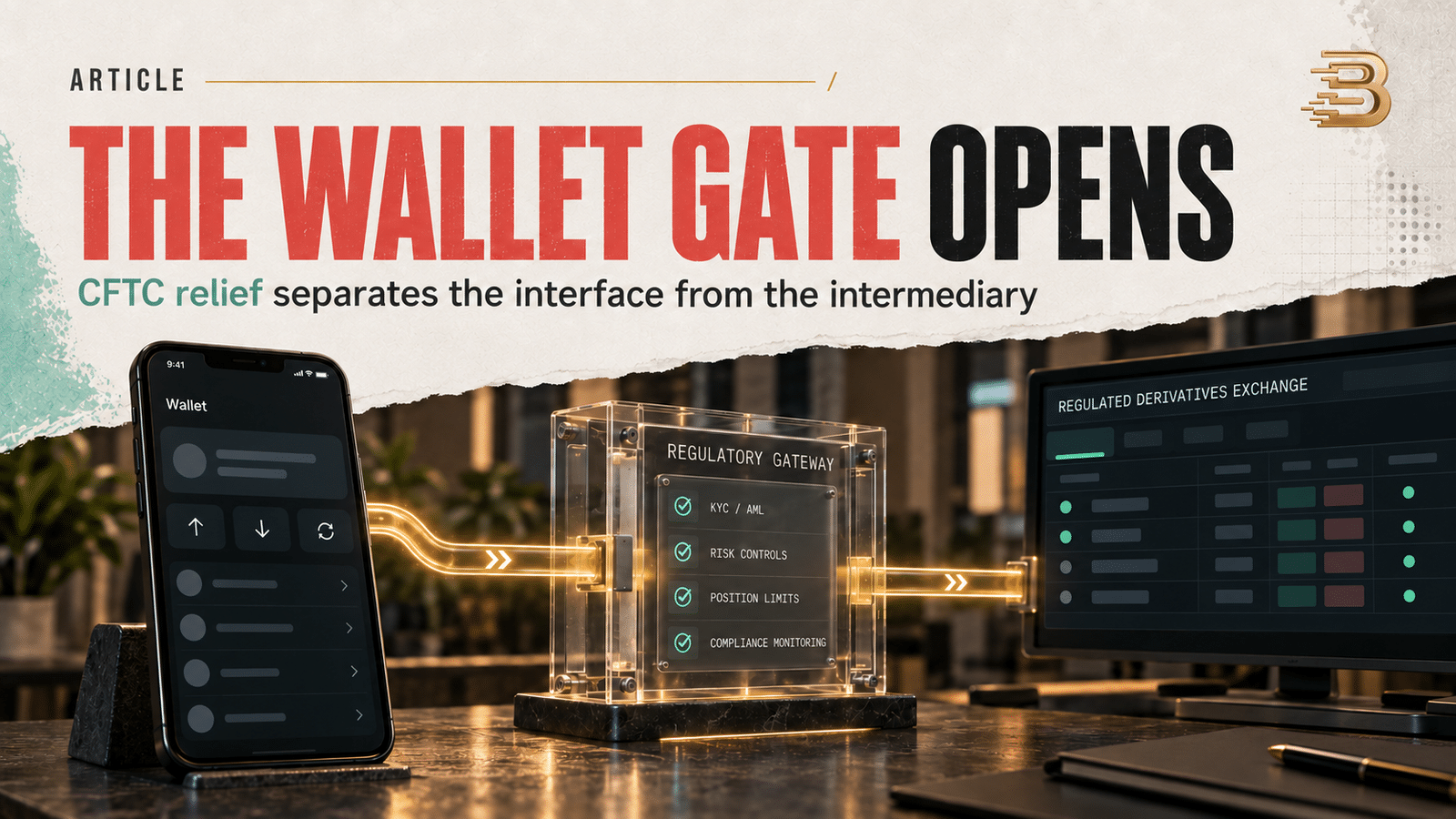
The most important part of the Commodity Futures Trading Commission’s new passive-software relief is not that a crypto wallet may display a prediction market or a perpetual contract. It is that the regulator has drawn a usable line between the interface a customer touches and the regulated intermediary that actually carries the trade. That distinction turns wallet distribution into a financial-market variable.
On September 17, 2026, the CFTC’s Market Participants Division made a no-action position broadly available to qualifying providers of “passive software.” Under the conditions in CFTC Staff Letter 26-25, staff will not recommend enforcement solely because a software provider or relevant personnel did not register as an introducing broker or associated person while offering a front end through which users reach registered derivatives firms and markets.
This is narrower than deregulation and more consequential than a technical exemption. The software provider does not become the exchange, clearinghouse, futures commission merchant or custodian. Customer assets and regulated positions stay with the registered market structure. Yet the wallet or app may present products, transmit customer instructions, market the relationship and receive transaction-linked compensation. In other words, the regulated core remains in place while the customer-acquisition layer can move outward.
That architecture resembles what happened in payments, cloud computing and consumer banking: the balance sheet and legal obligations stayed concentrated, while distribution spread through software. For crypto wallets, the opportunity is obvious. A product that was previously a key manager and gateway to decentralized applications can become a launch surface for federally regulated contracts. The less obvious consequence is that wallets may compete less on chain support and more on the quality, economics and governance of the regulated venues they embed.
The Rule Change Is About Function, Not Labels
The phrase “passive software” sounds as if the provider merely displays information. The actual relief covers considerably more. The seven-page Staff Letter 26-25 describes software that can let users review market data, aggregate positions, view product offerings and submit orders directly to registered entities. Covered products may include event contracts, perpetual contracts and other CFTC-regulated derivatives. The provider may promote the availability of particular contracts, introduce users to specific registered firms and earn revenue shared by those firms or charge transaction-based fees to users.
Those features matter because they would normally raise a broker-registration question. An introducing broker is not defined only by holding customer money or manually placing an order. The relevant statutes and regulations reach solicitation and the acceptance of orders, and CFTC interpretations have historically treated referrals and trade-linked compensation as evidence that a party is acting as an intermediary. A wallet with a “Trade” button, a featured contract and a revenue share can therefore look economically similar to a broker even if its code never touches the customer’s collateral.
The relief does not deny that similarity. It manages it through conditions. The provider may supply the interface and commercial funnel without registering as an introducing broker if the actual market access, custody and execution remain with registered entities and the provider accepts a package of disclosure, conduct, recordkeeping and liability obligations. That is why the functional boundary is more important than the product’s name. Calling an app a wallet, portal, browser extension or technology vendor does not decide its regulatory treatment. What matters is who controls assets, who receives the order, who routes it, who carries the account and which party bears responsibility when something goes wrong.
The CFTC’s own investor guidance says that intermediaries acting for others in futures, swaps or options generally must register, while firms facilitating virtual-currency derivatives must be registered with the CFTC and National Futures Association. Its registration explainer links that status to background checks, financial requirements, examinations, disclosures and conduct standards. Staff Letter 26-25 is therefore not a declaration that interfaces are harmless. It is a conditional judgment that the registered rail can remain responsible while a separate software layer handles discovery and transmission.
Phantom Was the Prototype; the New Letter Makes the Model Portable
The September letter generalizes an arrangement first developed for Phantom Technologies. In March, Staff Letter 26-09 described Phantom’s self-custodial wallet software and a proposal to add access to regulated derivatives. Phantom’s wallet generated and managed cryptographic credentials for several blockchains but did not custody crypto assets. The proposed derivatives feature would use a different model: orders would go to a designated contract market, futures commission merchant or introducing broker, and collateral would remain with the relevant clearing organization or registered intermediary.
That combination is the key. A user may begin inside a self-custodial wallet, but the regulated derivative does not become a self-custodial instrument merely because the entry point is a wallet. The letter expressly described the planned trading model as custodial and consistent with existing exchange-traded derivatives architecture. Phantom would provide software on the user’s device or browser, while the order moved directly to the registered collaborator. Phantom would not hold the assets, generate explicit buy or sell signals, exercise discretion over routing or execution, or take affirmative action on a particular order.
The first letter solved a company-specific problem. The second solves a market-wide scaling problem. No-action letters ordinarily protect only their beneficiary, so other wallet developers could not simply rely on Phantom’s arrangement. Staff Letter 26-25 responds to inquiries from similarly situated providers and makes substantially the same position available to any qualifying provider that files the required notice and observes the conditions.
That turns a bespoke permission into a reusable distribution template. The economic value is not limited to Phantom. Any wallet, fintech app or software platform that can satisfy the conditions may seek relationships with registered venues and intermediaries. The result could be a many-to-many market: multiple front ends competing to distribute products from multiple regulated back ends, rather than each venue building its own consumer interface and each wallet negotiating from regulatory scratch.
The Interface Can Be Separate, but Responsibility Cannot Disappear
The relief’s ten conditions show where the CFTC believes risk should sit. Providers and relevant principals cannot be subject to statutory disqualification without a waiver. Users must receive disclosures about the provider’s relationship with registered counterparties, including conflicts and fees. Relevant risk disclosures must be delivered and acknowledged. Users must become direct members or customers of the registered venue or intermediary and must retain the ability to access that entity independently of the software provider.
The provider must also follow public-communications and marketing rules as if it were a registered introducing broker. Promotions that would require NFA pre-approval for a registered broker are outside the permitted model. The provider must maintain records, notify staff of insolvency or bankruptcy and submit a notice agreeing to the letter’s terms and the CFTC’s enforcement jurisdiction.
The strongest condition is joint and several liability. The passive-software provider and each participating registered firm must execute a written undertaking making them jointly and severally liable for violations connected to the covered activities. That means the legal separation between interface and intermediary is not a liability escape hatch. If the wallet’s marketing, solicitation or other covered conduct violates the Commodity Exchange Act or CFTC regulations, the registered partner cannot necessarily point to the software layer and walk away. Both sides have a reason to police product design, disclosures and communications.
This is an important departure from the mythology that software can be “just code” whenever regulation becomes inconvenient. The letter treats code as passive only in a specific operational sense: the provider does not affirmatively handle an individual order, control collateral or exercise execution discretion. It does not treat the provider as economically irrelevant. Marketing, fees, product placement and user acquisition all remain visible to the regulator.
The boundary is therefore best understood as modular supervision. Execution and custody obligations remain with registered market infrastructure. Interface conduct is governed by conditions that borrow broker-like standards without imposing the full registration category. Liability connects the modules. The model may reduce duplicative licensing, but it does not remove accountability.
Why Wallet Distribution Changes the Economics of Regulated Derivatives
Traditional derivatives distribution starts with a brokerage relationship. The customer opens an account, completes onboarding, funds it and then uses the broker’s interface to reach an exchange. Crypto wallets invert that sequence. The user already has an interface, an identity relationship with the software and a habit of discovering financial products inside it. A regulated venue that integrates with the wallet can meet the user where attention already exists.
That lowers one type of friction while preserving another. Account opening, suitability checks where applicable, risk disclosures and registered custody do not vanish. But discovery, navigation and repeat engagement can happen inside a familiar product. The difference is commercially significant. Financial platforms spend heavily to acquire funded accounts; wallets already aggregate millions of financially active users. Even a modest conversion rate can create meaningful order flow for a venue.
Revenue sharing intensifies the incentive. Staff Letter 26-25 permits arrangements under which a registered firm shares relevant revenue with the software provider, and it also contemplates transaction-based fees charged to users. This aligns the wallet with trading activity rather than passive asset storage. The wallet’s business model can shift from swap spreads, staking integrations and token promotions toward regulated derivatives distribution.
But transaction-linked compensation also changes product incentives. A neutral interface earns more when users trade more. That creates familiar brokerage questions about gamification, contract placement, notifications and the difference between education and solicitation. The letter’s marketing restrictions and conflict disclosures address part of that risk. The harder issue will be design: whether the most prominent contracts are selected because they are useful to customers, lucrative for the provider or strategically important to a partner.
This is why the development should be read alongside the failure of the CLARITY Act to advance in the Senate. As Block2Learn explained in Why 50 Votes Still Failed Crypto, agency action can create workable pathways for specific activities even when Congress cannot deliver a comprehensive market-structure settlement. The trade-off is durability. A no-action position is narrower and more reversible than legislation, so firms may invest in distribution before the legal foundation is permanent.
Prediction Markets Are the Immediate Test Case
Event contracts are a natural first product because they are simple to display and already have strong consumer recognition. The CFTC describes event contracts as derivatives based on future outcomes, often structured as yes-or-no positions with fixed payouts. Their prices can be interpreted as market-implied probabilities. Regulated venues must establish rules, monitor activity and protect customer funds through the relevant intermediaries.
A wallet can translate that structure into a familiar consumer interaction: choose a market, review the price, submit an order and monitor the position. The interface may feel closer to a poll, a sports app or a crypto swap than to a futures brokerage. That familiarity can increase participation, but it can also obscure the fact that the user is entering a regulated derivative with financial risk, settlement rules and potential tax consequences.
The debate around prediction markets also shows why federal distribution has strategic value. State gaming regulators and federally regulated derivatives venues disagree over whether sports and other event contracts are financial instruments or gambling products. The conflict has produced litigation and inconsistent access. Block2Learn’s analysis of the Kalshi ruling and the prediction-market split showed that the product’s legal classification determines which regulator controls distribution.
Wallet integration does not resolve that federal-state fight. It amplifies its stakes. If a federally regulated venue can reach users through widely installed software, its distribution advantage becomes national and immediate. If courts or regulators later narrow which event contracts can be listed, the same front ends may need to remove products quickly across millions of devices.
The consumer-protection debate will follow distribution. The Associated Press has documented the rapid growth of sports-linked prediction markets and concerns from leagues and other stakeholders about integrity and bettor behavior. Its overview of prediction markets and sports also explains the basic peer-to-peer contract structure. A wallet does not take the other side of a customer’s position, but its notifications, rankings and interface choices can still affect how much and how often users trade.
The Custody Split Is Both the Feature and the Confusion Risk
Crypto users associate wallets with possession. A self-custodial wallet normally lets the user control cryptographic credentials and sign transactions. Regulated derivatives do not fit that mental model. Under the CFTC framework described in the letters, the user’s margin or collateral for a derivatives position remains with the designated contract market’s clearing organization or an FCM, not inside the wallet software.
This split is the architecture’s safety valve. It prevents a software provider from becoming a hidden custodian and keeps customer protections, segregation requirements and clearing obligations with regulated institutions. It also creates a user-experience challenge. A single screen may show self-custodied tokens beside positions whose assets and legal claims sit elsewhere. “In my wallet” can mean visible through the wallet, not legally or technically held by it.
Good interface design must make that distinction impossible to miss. The user should know which entity holds collateral, which entity executes the order, how withdrawals work, what happens if the wallet is unavailable and whether the position can be managed directly with the registered firm. Staff Letter 26-25 requires independent access to the registrant, which reduces lock-in and operational dependency. But the benefit exists only if users understand and can exercise it.
This is also where wallet reputation becomes transferable. Users may trust a familiar interface and assume that every embedded product inherits the wallet’s security model. In reality, smart-contract risk, exchange risk, clearing risk and counterparty risk vary by product. Distribution can borrow trust faster than customers learn the new risk stack. The registered partner and wallet therefore need disclosure that is operational, not merely legal: clear account ownership, separate balances, visible fee paths and a straightforward route to the underlying intermediary.
Distribution Becomes the New Moat
Crypto infrastructure has often treated liquidity as the decisive moat. The CFTC relief adds distribution to that equation. A regulated venue may have robust surveillance, clearing and product approval but limited consumer reach. A wallet may have extraordinary reach but no authority to carry customer derivatives accounts. Their partnership combines those complementary assets.
This favors three groups. First, wallets with large active user bases can negotiate better economics and broader product menus. Second, registered venues with reliable application programming interfaces can distribute through many front ends. Third, compliance and identity providers that help reconcile wallet users with regulated account onboarding may become essential middleware.
The losers may be stand-alone interfaces that add little beyond what the wallet already supplies. If the customer can discover a contract, onboard with the registrant and manage positions without leaving a familiar app, a separate brokerage application must justify itself through execution tools, research, pricing or service. The relief may therefore unbundle the broker’s interface from its regulated balance sheet and market access.
That resembles the shift explored in Block2Learn’s work on bank middleware: the Coinbase–Stablecore partnership showed how regulated institutions can keep the customer relationship while specialized infrastructure supplies digital-asset capabilities. Passive-software relief runs the pattern in the opposite direction. The crypto interface keeps the user relationship while regulated derivatives institutions supply the account, execution and custody.
Compliance Moves Into Product Design
The framework makes compliance a software specification. A provider must distinguish regulated activity from other wallet functions. It must deliver and retain acknowledgments of required disclosures. It must present fees and conflicts accurately. It must avoid communications that would trigger prohibited or pre-approval-dependent promotion. It must preserve records in a regulator-compatible form.
Those obligations cannot be bolted on at launch. Product teams will need event logs for disclosure delivery, version control for terms, auditable routing records and jurisdiction-aware product menus. Marketing teams will need review workflows comparable to those used by registered brokers. Partnership contracts must allocate operational duties while preserving the joint-liability undertaking required by the letter.
The architecture also needs graceful failure. If a registered venue is unavailable, the wallet must not imply that a user’s position disappeared. If the interface relationship ends, customers must still be able to reach the registrant. If the provider enters insolvency, records and customer access cannot depend on its continued operation. These are product-resilience questions as much as legal ones.
For regulators, software-level compliance may improve observability. A well-designed front end can standardize disclosures, capture acknowledgments and produce consistent records across users. It can also change behavior rapidly at scale. A single interface update can alter which contracts millions of people see. The same efficiency that helps compliance can magnify a flawed promotion or disclosure, making governance over software releases a market-integrity issue.
This Is Not a General Safe Harbor for DeFi
The relief should not be confused with blanket permission for decentralized protocols, unregistered exchanges or offshore derivatives. Covered orders must go directly to registered entities. Users must be direct members or customers of those entities. Collateral and positions follow the existing regulated clearing structure. The provider must accept CFTC jurisdiction for the covered conduct.
That is far from a permissionless model in which a wallet connects to an autonomous smart contract, posts collateral on-chain and trades a perpetual future without an identifiable intermediary. The CFTC letter does not resolve whether developers, governance participants or interface operators for those systems must register. It offers a compliant bridge from consumer software into the registered market, not a regulatory exemption for every protocol the software can reach.
The distinction may create a two-track wallet. One tab connects users to decentralized protocols under one risk and legal model. Another connects them to CFTC-regulated derivatives under a custodial account and a different set of disclosures. The same application may support both, but the economic and legal rails remain separate.
That separation could become a competitive feature. Users who want regulated event contracts or derivatives can choose the supervised rail. Users who want self-custodial on-chain products can see that they are leaving it. The danger is interface blur: if both experiences look identical, users may not understand which protections apply. The best products will make the boundary visible without turning every trade into a legal maze.
Token Value Capture Is Not Automatic
Crypto markets often translate wallet adoption into a token thesis too quickly. Passive-software relief does not require that regulated derivatives settle on a public blockchain, use a wallet token or generate demand for a network’s native asset. The front end may be crypto-native while execution, collateral and clearing occur entirely within conventional regulated infrastructure.
A wallet company can capture value through fees, revenue sharing, user retention and cross-selling. A registered venue can capture value through volume and account growth. A compliance provider can capture value through onboarding and monitoring. None of those flows necessarily accrue to a blockchain token.
Token value capture would require an additional mechanism: collateral held in a tokenized form, settlement on a public network, fees paid in a native asset, or increased demand for block space. The CFTC letters do not establish any of those conditions. Investors should therefore separate three claims that may travel together in marketing but are economically distinct: wallets may gain distribution power; regulated derivatives may gain customers; and a particular token may appreciate. The first two can occur without the third.
The same discipline applies to tokenized securities. Block2Learn’s analysis of the SEC’s tokenized-stock exemption emphasized that putting an asset on a blockchain does not erase the issuer, ownership rights or market rules. Here, putting a regulated product inside a wallet does not make the wallet the custodian or the blockchain the settlement layer.
Three Scenarios for the Next Twelve Months
Scenario one: regulated distribution scales quickly. Several major wallets file notices, sign agreements with registered venues and add event contracts or other derivatives. User acquisition costs fall for venues, and wallets add a meaningful transaction-revenue stream. Competition shifts toward product selection, fees, interface quality and the reliability of the embedded registrant. This is the most bullish scenario for wallet businesses, though not necessarily for wallet-linked tokens.
Scenario two: compliance makes the model selective. Joint liability, marketing rules, recordkeeping and integration costs deter smaller wallets and venues. A few large providers dominate because they can fund legal review, audit trails and operational resilience. Distribution expands, but the market becomes more concentrated. Users gain convenient access while regulators face a small number of powerful software gatekeepers.
Scenario three: policy reverses or narrows. Litigation over prediction markets, a change in CFTC leadership or a future rulemaking changes the treatment of passive software. Existing partnerships must be redesigned, registered or discontinued. Because Staff Letter 26-25 lasts only until effective Commission rulemaking or guidance addresses the issue, the business model contains regulatory duration risk from the start.
These scenarios are not mutually exclusive. Event contracts may scale while perpetual contracts face greater scrutiny. Large wallets may proceed while smaller providers wait. The CFTC may preserve the interface-intermediary distinction but add capital, cybersecurity or reporting obligations. Investors and builders should follow implementation, not merely the initial announcement.
What to Watch
The first signal is the number and identity of providers that file notices under Staff Letter 26-25. A broad group would indicate that the conditions are commercially workable. A narrow group would suggest that joint liability and operational requirements limit the addressable market.
The second is partnership structure. Revenue shares, fee disclosure and control over product placement will reveal which side owns the customer relationship. The party that controls discovery and default choices often captures more economics than the party supplying commoditized infrastructure.
The third is custody transparency. Interfaces should distinguish self-custodial crypto assets from collateral held through registered derivatives infrastructure. Confusion here would invite complaints and regulatory attention even if the legal structure is sound.
The fourth is federal-state litigation over event contracts. A wallet can distribute only what the venue may lawfully list. Court decisions affecting sports, elections or other event categories will determine how valuable national software distribution becomes.
The fifth is rulemaking. The letter is an interim enforcement position, not a permanent statutory category. A Commission proposal could codify the model, narrow it or replace it. Comments on any future rule will show whether traditional brokers see passive software as healthy competition or regulatory arbitrage.
The Block2Learn Assessment
CFTC passive-software relief is best understood as a distribution reform. It preserves regulated custody, execution and clearing while allowing consumer software to become the storefront. That can expand access and competition because every wallet does not need to recreate the full broker stack. It can also concentrate influence in the interfaces that control attention.
The model works only because responsibility remains connected. Disclosures, marketing standards, recordkeeping, direct customer relationships with registrants and joint liability keep the software layer inside the regulatory perimeter even when it sits outside full introducing-broker registration. The interface is separate; accountability is not.
For wallet companies, the opportunity is to become the operating system for financial access. For registered venues, it is to acquire customers without owning every screen. For users, the benefit is convenience, but the risk is mistaking a familiar wallet for the legal home of every asset and position it displays.
The strategic conclusion is therefore narrower than “crypto wins.” Regulated derivatives are becoming embeddable. Wallets can capture part of the customer relationship. Value will accrue to the firms that combine distribution with credible compliance, clear custody boundaries and resilient access. Public blockchains and tokens benefit only when the economic flow actually touches them.
Continue Through the Block2Learn Learning Path
- Read how crypto infrastructure becomes bank middleware when regulated institutions keep the customer relationship.
- Compare wallet distribution with the SEC’s tokenized-stock infrastructure model.
- Study why atomic settlement moves risk into governance rather than eliminating it.
This article is provided solely for informational and educational purposes and does not constitute financial or investment advice, a recommendation, or an offer or solicitation to buy or sell any financial instrument or digital asset. See our Financial Disclaimer.
This article was generated with the support of AI and reviewed by the Editorial Team. For more information, see our Terms of Service.


