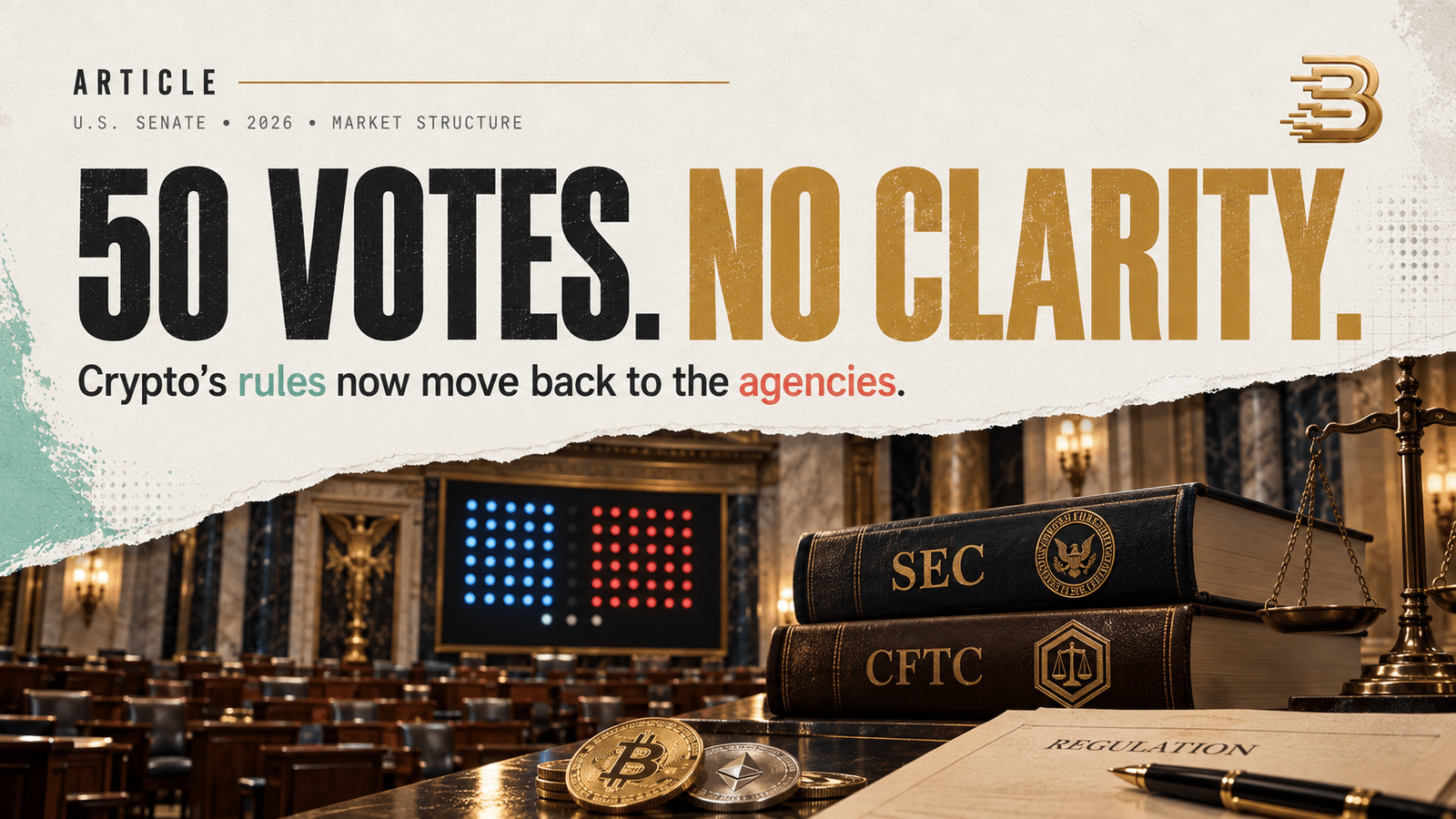
The CLARITY Act vote did not fail because the Senate preferred a different crypto market structure. It failed because 50 votes in favor were not enough to clear a 60-vote procedural threshold. That distinction matters. A majority of senators supported moving forward, yet the bill still stalled, leaving exchanges, token issuers, investors and regulators with the same fundamental problem: the United States has political demand for clearer digital-asset rules but not yet a coalition strong enough to make those rules durable.
On September 15, 2026, the Senate voted 50–49 in favor of advancing the legislation. Four Republicans joined every voting Democrat in opposition, and the motion fell ten votes short of the threshold required. Reuters reported that Senator Thom Tillis changed his vote for procedural reasons, preserving the possibility of reconsideration. That keeps the bill technically alive. Politically, however, the approaching recess and midterm elections make an immediate revival difficult.
The market’s first reaction was to treat the result as a binary loss for crypto. Bitcoin fell sharply as the vote appeared likely to fail, while Coinbase and Circle shares also declined. But the more important consequence is not one day of price action. The CLARITY Act vote shifts the next phase of U.S. crypto policy away from Congress and back toward the Securities and Exchange Commission, the Commodity Futures Trading Commission, the courts and the compliance decisions made by individual firms.
That is not the same as a regulatory vacuum. It is a return to fragmented authority. Agencies can interpret existing laws, propose exemptions and define pathways for particular activities. They cannot easily deliver the stable, comprehensive division of responsibilities that only legislation can create. Crypto’s real test now is whether an agency-led framework can support investment and consumer protection without becoming another temporary settlement that changes with the next administration or lawsuit.
A Majority Was Not Enough
The headline number invites a misleading conclusion. In most settings, 50 votes in favor and 49 against would look like passage. In the Senate, advancing major legislation often requires ending debate through cloture, and the chamber’s own historical explanation of cloture shows why a supermajority can decide whether a bill reaches a final vote. The September 15 motion therefore tested whether the proposal could assemble a broad enough coalition to proceed, not simply whether more senators liked it than disliked it.
The result exposes a recurring problem in digital-asset policy. There is substantial agreement that existing rules are incomplete, but agreement on the existence of a problem does not produce agreement on the remedy. Supporters saw the bill as a way to define federal guardrails, clarify jurisdiction and reduce the legal uncertainty that pushes activity offshore. Opponents objected to ethics provisions, enforcement design and the distribution of benefits between the industry, consumers and politically connected actors.
The Associated Press reported that Democrats demanded stronger restrictions involving presidential crypto holdings and future conflicts of interest. Last-minute concessions did not close the gap. Four Republican senators also voted against advancement. The coalition therefore broke for several reasons at once: ethics, banking and stablecoin concerns, enforcement design, election-year incentives and disagreement over whether the latest text had received enough scrutiny.
For investors, the lesson is that “pro-crypto” and “anti-crypto” are too blunt to describe the legislative map. A senator may favor digital-asset regulation and still reject a specific allocation of powers. A lawmaker may support blockchain innovation but oppose a stablecoin provision that could affect bank deposits. Another may favor market-structure rules but refuse to separate them from ethics safeguards. The failed vote was not a national referendum on whether crypto should exist. It was evidence that market structure now intersects with banking, securities, commodities, political ethics and consumer protection in ways that prevent a single-issue coalition.
What Market Structure Actually Means
Market structure is the legal and operational architecture that determines who may issue, list, trade, custody, clear and settle an asset. In traditional finance, these functions sit inside established categories. Securities exchanges, broker-dealers, clearing agencies, futures commission merchants and banks operate under different statutes and supervisory systems. Digital assets combine many of those functions in software, often across borders and sometimes inside a single platform.
The hardest question is not whether “crypto” is regulated. Many crypto activities already fall under rules governing securities, commodities, money transmission, banking, sanctions, taxation and fraud. The hard question is which rules apply to a particular asset or transaction, when they apply, and whether a platform can comply without forcing a genuinely different technical system into an unsuitable category.
Consider a token launched to finance development of a network. During the fundraising stage, purchasers may rely heavily on a promoter’s promised work. Years later, the network may be open, software may be maintained by multiple parties and the token may trade primarily as a consumptive or settlement asset. A static label applied at issuance may not describe the later market. Yet a rule that allows every issuer to declare decentralization would invite evasion. Durable legislation must define the transition with evidence, disclosures, oversight and enforceable consequences.
Trading platforms create another boundary problem. A venue may list tokens, provide custody, match orders, route transactions on-chain and offer derivatives or staking services. In conventional markets, those roles are often separated because conflicts of interest and operational concentration can harm customers. Crypto’s technical integration can improve settlement speed, but it can also concentrate risk. The correct policy question is not whether integration is innovative. It is which functions may be combined, which must be segregated and what capital, disclosure, surveillance and recovery obligations follow.
This is why Block2Learn has treated market structure as more than a legal headline. Our analysis of the White House crypto market-structure plan argued that the decisive issue was implementation across agencies, not political branding. The failed Senate vote confirms that the institutional handoff is now the story.
The Bill’s Failure Does Not Freeze Regulation
Congress can create new statutory categories and assign authority with greater permanence. Agencies must work within laws already on the books. That difference limits them, but it does not make them passive. The SEC has already proposed “Regulation Crypto Assets,” a framework intended to create tailored offering exemptions and a conditional safe harbor for certain investment contracts involving crypto assets.
According to the SEC’s August 18 proposal, one exemption would permit offerings of up to $5 million over four years, while another would permit up to $75 million in a twelve-month period, subject to disclosures and, for the larger exemption, financial statements and ongoing reporting. The proposal also describes conditions under which a crypto asset would no longer be treated as subject to an investment contract once essential managerial efforts are complete or permanently ceased.
Those provisions matter because they address the lifecycle problem directly. They attempt to separate the security-like financing arrangement from the digital object that may later circulate in a different context. Our earlier examination of the SEC’s crypto offering exemptions and safe harbor explained why this could redesign token financing even without a comprehensive act of Congress.
But agency action has structural limits. An SEC rule cannot rewrite the Commodity Exchange Act. It cannot settle every boundary between spot-commodity platforms and securities venues. It cannot bind future commissioners to the same enforcement priorities. It remains vulnerable to litigation over statutory authority, administrative procedure and the reasonableness of its classifications. A CFTC initiative faces parallel limits on the other side of the jurisdictional divide.
This produces a patchwork that can be workable for specific use cases yet unstable for the system as a whole. A token issuer may obtain a clearer offering pathway while an exchange remains uncertain about listing obligations. A custodian may operate under one supervisory regime while a decentralized protocol falls outside the same perimeter. A stablecoin issuer may comply with reserve rules while its distribution partners face different state and federal requirements.
The Regulatory Burden Moves Into Firm-Level Decisions
When legislation stalls, uncertainty does not disappear. It migrates. Boards, compliance teams, auditors, investors and courts must make more of the decisions that Congress declined to settle.
An exchange deciding whether to list a token must evaluate how regulators could classify it, what disclosures exist, whether trading can be surveilled and whether liquidity is sufficiently broad to resist manipulation. A token foundation must decide whether grants, governance influence or ongoing development create reliance on managerial efforts. A custodian must assess how to separate customer assets and respond if an underlying protocol changes. A stablecoin distributor must consider whether rewards resemble interest, marketing incentives or another regulated product.
These are not abstract questions. They influence which products launch in the United States, which users are excluded, how much capital firms reserve for legal risk and whether new activity migrates offshore. Large incumbents can absorb uncertainty more easily than smaller firms. They can retain counsel, build multiple licenses and negotiate with regulators. Startups often cannot. That means legal ambiguity can concentrate the market even when policymakers intend to encourage competition.
The failed CLARITY Act vote therefore favors a barbell. At one end are large regulated firms with the resources to navigate overlapping regimes. At the other are decentralized or offshore systems that minimize their U.S. footprint. The middle—domestic builders seeking a clear, proportionate route to market—faces the greatest friction.
This also changes what counts as a competitive advantage. In a mature market, execution quality, fees, security and product design should dominate. In a fragmented regime, regulatory optionality becomes part of the moat. A firm with broker-dealer, commodity, banking or trust relationships can adapt faster than a technically stronger rival without those connections. Regulation is necessary, but uncertainty about regulation can distort competition as effectively as bad rules.
Why the SEC–CFTC Boundary Still Matters
The simplified version of U.S. crypto policy assigns securities to the SEC and commodities to the CFTC. The real system is more complicated. The CFTC regulates derivatives markets comprehensively, but its authority over spot commodity markets is more limited and often centered on fraud and manipulation. The SEC regulates securities offerings, intermediaries and trading venues. Crypto products can move across those categories depending on their design and use.
That boundary affects everything from registration to customer protection. A securities exchange faces listing standards, issuer disclosure, broker-dealer rules and a particular market-surveillance framework. A commodity derivatives venue operates under a different structure. Spot crypto platforms may perform functions that resemble both while also offering custody and on-chain settlement.
Legislation can create a transition rule: an asset may begin inside a securities framework, meet defined decentralization or maturity conditions and later trade under a commodity-oriented regime. Without legislation, agencies can coordinate, interpret and grant relief, but they cannot eliminate every statutory seam.
The distinction between the asset and the transaction is crucial. A digital token is not automatically a security in every context merely because one fundraising transaction involved an investment contract. Conversely, calling a network decentralized does not erase the economic reality of a promoter raising money from buyers who expect that promoter to create value. Good rules must analyze the transaction, the network’s development stage, governance concentration, disclosures and the role of intermediaries.
That framework also explains why tokenized traditional assets require separate treatment. A token representing a share or bond does not stop being a security because settlement occurs on a blockchain. Our analysis of tokenized-equities settlement risk showed that direct shares and contractual wrappers can create very different claims. Technology changes the rails; it does not automatically change the legal substance.
Ethics Became a Market-Structure Variable
Some investors may view the ethics dispute as political noise unrelated to token economics. That would be a mistake. A market-structure law depends on legitimacy. If voters believe rules were designed to benefit officials with financial interests in the industry, the framework may not survive a change in power. A bill passed without credible conflict safeguards could produce less certainty, not more, because repeal, litigation or hostile implementation would remain likely.
The AP reported that negotiations included proposed restrictions on elected officials issuing digital assets and demands for stronger divestment provisions when holdings reach specified levels. Those questions are politically charged, but the underlying governance principle is familiar: officials who shape a market should not be able to use privileged influence to enrich themselves through that market.
Crypto intensifies the problem because tokens can be issued quickly, trade globally and generate value through fees, governance rights, branding or privileged allocation. Traditional disclosure systems may capture some interests while missing others. A comprehensive ethics regime therefore has to address direct holdings, beneficial ownership, family interests, token issuance, promotional activity and revenue tied to protocols or affiliated companies.
The practical conclusion is not that market-structure legislation must wait for perfect ethics rules. It is that the two issues have become inseparable. Any renewed bill will need enough substantive investor protection and enough political legitimacy to survive beyond the coalition that passes it.
Stablecoins and Banks Complicate the Coalition
Stablecoins are often presented as the least controversial part of crypto regulation because their function is easy to explain: maintain a stable value, hold reserves and support payments or settlement. In practice, stablecoins connect digital assets directly to bank deposits, Treasury-bill demand and payment-system economics.
If users move cash from bank accounts into stablecoins, the banking system may lose low-cost deposits. Stablecoin issuers or their partners may then invest reserves in short-term government securities. The dollar remains inside the financial system, but its location, maturity and run dynamics change. Our analysis of the stablecoin growth paradox showed how the same expansion can support Treasury demand while concentrating redemption pressure and altering bank funding.
Rewards make the conflict sharper. A stablecoin issuer may be prohibited from paying interest directly while an exchange or wallet offers incentives funded through commercial arrangements. Banks see deposit competition. Crypto firms see a legitimate way to share economics with users. Policymakers see a boundary that can be exploited if statutory language is too narrow.
This is one reason market-structure legislation cannot be isolated from banking policy. Rules for exchanges affect how stablecoins are distributed. Rules for reserves affect liquidity. Rules for rewards affect competition with deposits and money-market funds. Consumer-protection standards affect redemption rights and disclosures. A coalition that agrees on token classification can still fracture over these downstream effects.
What the Market Reaction Did—and Did Not—Prove
Reuters reported that Bitcoin fell more than 5% as the vote appeared headed for defeat, while Coinbase and Circle shares dropped as much as 10%. Those moves show that investors had assigned value to near-term legislative progress. They do not prove that the vote alone caused every decline.
Markets were also processing tighter financial conditions and a broader risk repricing. Bitcoin trades as a monetary asset, a liquidity-sensitive technology exposure and a vehicle for leveraged positioning. Coinbase and Circle have business models directly connected to trading activity, custody, stablecoins and U.S. regulation. A political shock can therefore hit each asset through a different channel.
For Bitcoin, the main legislative benefit would have been a stronger institutional framework around venues and intermediaries, not a change to the protocol itself. Bitcoin continues to produce blocks regardless of a Senate vote. The economic effect operates through access, custody, market depth, compliance and the willingness of institutions to allocate capital.
For Coinbase, jurisdictional clarity can reduce product-launch risk and compliance cost. For Circle, stablecoin treatment affects distribution, reserves and competitive economics. The same vote can therefore alter expected cash flows for listed companies more directly than it alters the fundamental supply schedule of a decentralized asset.
Investors should also distinguish price from proof. A sharp decline can reveal crowded expectations, leverage and sensitivity to policy. It cannot by itself establish the long-term value of a legislative framework. The correct response is to update probabilities: lower the likelihood of near-term congressional certainty, raise the importance of agency rulemaking and lengthen the expected timeline for a durable settlement.
Three Scenarios From Here
| Scenario | What changes | What investors should watch |
|---|---|---|
| Procedural revival | The bill returns after targeted negotiations on ethics, banking and enforcement. | New bipartisan sponsors, revised text, committee commitments and a credible path to 60 votes. |
| Agency-led bridge | SEC and CFTC actions create narrower pathways while Congress remains stalled. | Final rules, exemptions, interagency coordination, registrations and court challenges. |
| Extended fragmentation | Policy remains divided among agencies, states, courts and firm-level compliance decisions. | Product withdrawals, offshore migration, consolidation, state enforcement and inconsistent judicial outcomes. |
The first scenario is possible because the procedural vote preserves room for reconsideration. It is not the base case for an immediate breakthrough. A successful revival would require evidence that disputed provisions have changed and that supporters can identify ten additional votes, not simply repeat the same coalition.
The second scenario is already under way. The SEC proposal provides a concrete example of an agency trying to build a tailored regime under existing law. Coordination with the CFTC could reduce conflict, especially where platforms list assets that may occupy different categories. The weakness is durability. Rules may be challenged, narrowed or reversed.
The third scenario is the risk investors underestimate. Fragmentation does not necessarily produce a dramatic ban. It produces accumulated friction: delayed products, higher legal costs, inconsistent access, concentration among incumbents and recurring litigation. The market can grow under those conditions, but growth will be less efficient and more dependent on political cycles.
Indicators That Matter More Than the Next Headline
First, watch the text, not the slogan. A future bill may retain the CLARITY name while changing the provisions that matter most. Investors should compare definitions, transition rules, platform obligations, ethics restrictions, stablecoin rewards and enforcement powers line by line.
Second, watch registrations and product decisions. Agency guidance matters when firms use it. New registrations, compliant token offerings, venue approvals and custody arrangements would show that an agency-led pathway is commercially usable. Announcements without adoption are weaker evidence.
Third, watch the courts. Every major rule exists inside statutory boundaries. Court decisions can validate an agency’s interpretation, narrow it or send the issue back to Congress. Litigation timelines may therefore become part of the investment horizon.
Fourth, watch market concentration. If only the largest exchanges and issuers can navigate the framework, clarity may arrive at the cost of competition. Changes in listing breadth, compliance spending, market share and U.S. product availability will reveal whether rules are proportionate.
Fifth, watch stablecoin funding flows. Reserve composition, redemption behavior, exchange rewards and bank-deposit trends will show whether digital dollars are becoming payment infrastructure, investment substitutes or both.
Finally, watch operational trust. Regulation cannot substitute for secure systems. The recent Block2Learn examination of Coinbase’s continuous adversarial testing showed why exchange security is itself a market-structure issue. Clear jurisdiction is valuable only if the institutions inside that jurisdiction can protect assets and continue operating under stress.
The Block2Learn Assessment
The CLARITY Act vote is a setback for durable U.S. crypto legislation, but it is not the end of regulation and not proof that the industry has lost political influence. The more accurate conclusion is that influence can open the legislative door but cannot substitute for coalition design.
A lasting framework must solve four problems simultaneously. It must classify assets and transactions without creating an easy path for evasion. It must allocate authority between agencies without leaving platforms in permanent overlap. It must protect consumers and market integrity without making domestic entry viable only for incumbents. And it must contain ethics safeguards strong enough to preserve legitimacy across elections.
The vote also clarifies the difference between speed and durability. Agency action can move faster and solve targeted problems. Congressional legislation can create a broader and more stable settlement. The United States now needs both: agencies should use existing authority transparently, while lawmakers continue negotiating the statutory boundaries agencies cannot create on their own.
For investors, the correct framework is probabilistic rather than ideological. Do not ask whether Washington is “pro-crypto.” Ask which activities have a credible legal pathway, which firms can execute within it, which risks remain unresolved and how durable each policy action is likely to be.
The market’s decline after the vote reflected the loss of one favorable scenario: near-term comprehensive legislation. It did not erase the SEC’s proposal, existing commodity authority, state regimes, judicial precedents or the economic demand for digital settlement. It did, however, raise the value of compliance capability and lengthen the timeline for broad certainty.
Fifty votes revealed that crypto market structure has majority-level support. The ten missing votes revealed that support remains conditional. Until lawmakers bridge ethics, banking, enforcement and jurisdiction, the United States will regulate digital assets through a collection of narrower decisions. That can produce progress, but it will be slower, less uniform and more vulnerable to reversal than a durable statute.
Continue Through the Block2Learn Learning Path
Understanding the CLARITY Act vote requires more than following a Senate tally or a Bitcoin chart. Investors need to understand how securities law, commodity oversight, market infrastructure, stablecoin reserves, custody, conflicts of interest and political procedure interact. A rule that benefits an exchange may not benefit a token holder. A faster offering pathway may not resolve secondary-market obligations. A stablecoin framework may strengthen Treasury demand while increasing pressure on bank funding.
The Block2Learn Learning Path develops those connections progressively. Free Start introduces the language of markets, blockchains and risk. Foundation explains how capital, incentives and institutions shape outcomes. The Investor Operating System builds a repeatable process for separating evidence from narrative and updating probabilities when conditions change.
The Crypto Layer then examines token economics, custody, decentralized finance, market structure and regulatory design in greater depth. Those are the tools required to evaluate whether a future bill creates durable clarity or merely moves uncertainty from one part of the system to another.
A failed procedural vote is not the same as a rejection of the technology. A proposed agency rule is not the same as a permanent statute. A price decline is not the same as a fundamental verdict. Structure begins by making those distinctions.
Information is abundant. Structure is rare.
This article is provided solely for informational and educational purposes and does not constitute financial or investment advice, a recommendation, or an offer or solicitation to buy or sell any financial instrument or digital asset. See our Financial Disclaimer.
This article was generated with the support of AI and reviewed by the Editorial Team. For more information, see our Terms of Service.