
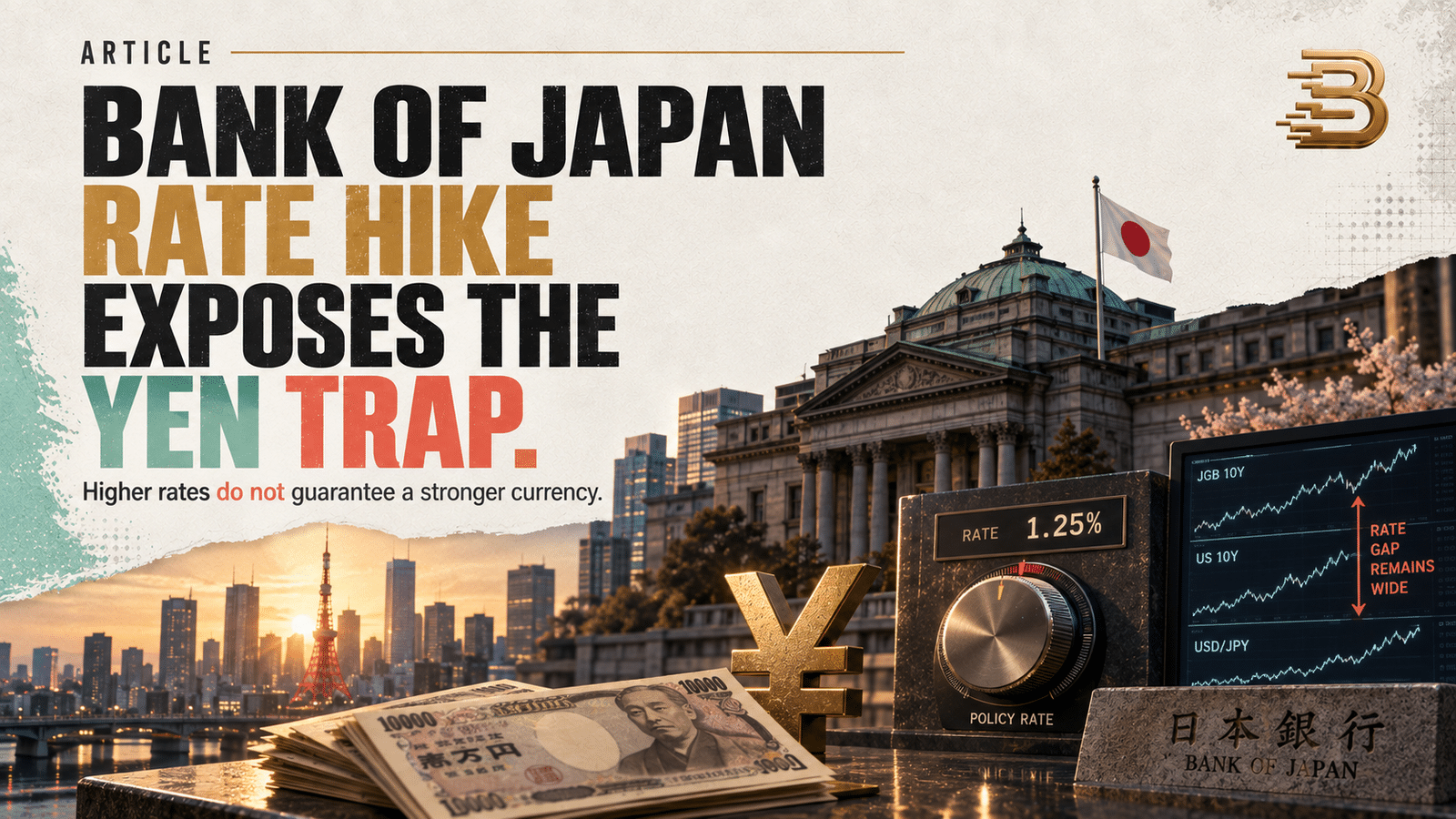
Bank of Japan rate hike sounds like the kind of event that should strengthen a currency. A central bank raises the return on domestic money, narrows the yield disadvantage against foreign assets and signals that inflation is no longer too weak to tolerate tighter policy. Yet the yen weakened after the Bank of Japan lifted its overnight call-rate target from around 1.0% to around 1.25%, the highest level in more than three decades. That apparent contradiction is the most important part of the decision.
The move was not a surprise. Markets had largely priced a quarter-point increase, and the Bank of Japan’s official decision confirmed both the 1.25% target and a 7–2 vote. The central bank also said that financial conditions would remain accommodative and that future increases would depend on economic activity, prices, financial conditions and risks. In other words, Japan raised rates without promising a rapid normalization cycle.
That combination explains why the currency response matters more than the headline. The yen is not trading on Japan’s policy rate in isolation. It is trading on the expected path of Japanese rates relative to the United States and other economies, the credibility of future tightening, energy-import costs, domestic capital allocation and the enormous stock of global positions that were built during decades of cheap yen funding. A higher rate can coexist with a weaker currency when the market concludes that the increase is too small, too anticipated or too cautious to change those forces.
The broader lesson reaches far beyond Japan. Monetary policy works through expectations and relative prices, not through a mechanical rule in which every hike produces currency appreciation. The Bank of Japan rate hike therefore offers a clean case study in how central-bank credibility, yield differentials and capital flows interact—and why the first market reaction is often a judgment about the next decision rather than the one just announced.
What the Bank of Japan Actually Changed
The policy board raised the uncollateralized overnight call-rate guideline to around 1.25%, effective September 24. It also raised the complementary deposit-facility rate to 1.25% and the basic loan rate to 1.5%. These are meaningful steps for an economy that spent years with rates near or below zero, but they still leave Japanese short-term rates well below those in the United States.
The accompanying assessment is more important than the numerical change. The Bank said Japan’s economy had recovered moderately, with support from government measures and global demand linked to artificial intelligence. It also highlighted high crude-oil prices, yen depreciation, strong producer-price inflation and continued efforts by companies to pass wage increases into selling prices. Underlying consumer inflation was described as approaching the 2% target, while medium- and long-term inflation expectations had continued to rise.
The official statement did not present the hike as a hard turn toward restrictive policy. It explicitly said real interest rates remained low, financial institutions were willing to lend and corporate bond issuance conditions remained favorable. The Bank’s own one-page policy summary described financial conditions as accommodative even after the increase. This is a normalization step, not an attempt to crush demand.
The vote also matters. Two board members opposed the increase because they judged that recent inflation and growth did not yet justify tighter policy. A dissent does not cancel the majority’s action, but it reveals the uncertainty around the future path. Currency traders care about whether 1.25% is the beginning of a sustained sequence or a cautious plateau. The decision supplied a higher current rate; the dissent reduced confidence in the speed of what comes next.
| Policy signal | Immediate reading | Currency implication |
|---|---|---|
| Overnight target raised to 1.25% | Normalization continues | Positive for the yen in isolation |
| 7–2 vote | Material internal caution remains | Weakens confidence in a rapid follow-through |
| Conditions still accommodative | Japan is not yet pursuing restrictive policy | Leaves the global yield gap wide |
| Future moves remain data-dependent | No fixed tightening timetable | Keeps the terminal-rate path uncertain |
Why the Yen Weakened After a Rate Increase
The simplest explanation is that markets trade the difference between reality and expectation. If investors already expected 1.25%, the increase itself contained little new information. The price response then depended on guidance, the vote and the perceived destination of policy. Reuters reported that the yen fell to around 157 per dollar after the decision as traders focused on the cautious signal and the two dissents. The Associated Press account likewise emphasized that the move had been anticipated and that the policy rate remained low by global standards.
This is a recurring feature of central-bank days. A rate hike can be “dovish” when it is smaller than feared, accompanied by soft guidance or expected to be the last move for some time. A rate cut can be “hawkish” when policymakers emphasize that further easing is unlikely. The label belongs to the entire expected path, not to the sign of the current change.
Japan’s path still begins far below the U.S. one. The Federal Reserve had just raised its own target range to 3.75%–4.0%, leaving a large short-term differential even after the Japanese increase. Block2Learn’s recent analysis of how the Fed tightened into economic strength showed why global investors continue to receive a materially higher nominal return from dollar cash and short-duration dollar assets. Currency hedging changes the calculation, but the unhedged carry incentive remains visible.
The market also knows that Japan’s central bank faces constraints that are different from those confronting the Fed. Higher rates improve income for savers and banks, but they also raise debt-service costs over time, pressure interest-sensitive borrowers and change the valuation of a large domestic bond market shaped by years of central-bank purchases. The Bank can normalize, but doing so too quickly risks destabilizing the financial structure built during the low-rate era.
That asymmetry creates a credibility problem. Traders do not need to believe that the Bank will reverse course immediately. They only need to doubt that Japanese rates will rise fast enough to close the gap. If U.S. rates remain high while Japan proceeds gradually, the yen can stay weak even as the domestic policy rate reaches a generational high.
The Rate Differential Is a Flow, Not Just a Number
The yield gap influences real portfolio choices. Japanese insurers, pension funds, banks and households compare domestic returns with foreign bonds and deposits. Global macro funds compare the cost of borrowing yen with the return available in dollars or other currencies. Corporations decide how much currency exposure to hedge. Each decision responds to expected returns, volatility, hedging costs and balance-sheet constraints.
A large differential encourages capital to seek higher yields abroad. The classic version is the yen carry trade: borrow or fund in yen at a low rate, convert the proceeds into a higher-yielding asset and earn the spread as long as the exchange rate does not move against the position. The trade can involve government bonds, credit, equities or derivatives. Its attraction depends on stability. A small yield advantage is not enough if the funding currency can surge suddenly.
The danger appears when many investors hold similar positions. A sharp yen appreciation raises the cost of repaying yen liabilities and can force deleveraging across unrelated markets. The global selloff associated with a previous carry-trade unwind illustrated how a change in Japanese policy can transmit through equities, bonds and volatility even when Japan is not the origin of the underlying economic shock. The mechanism is balance-sheet compression: investors sell what they can, not necessarily what caused the loss.
Today’s Bank of Japan rate hike changes the carry arithmetic at the margin. Funding is more expensive, and the expected path is higher than it was during the zero-rate era. But the incentive is not eliminated while foreign yields remain substantially higher. The market therefore asks whether the Bank is changing the regime or merely adjusting the price of a still-viable strategy.
This distinction resembles the funding logic explored in Block2Learn’s analysis of dollar-bond hedging and funding demand. A nominal yield cannot be read without the currency and hedge. The true return is the yield after financing, hedging, liquidity and basis costs. Japan’s domestic rate may have risen, yet the total relative return can continue to favor foreign assets.
Inflation Makes the Bank More Hawkish—and the Yen More Complicated
The Bank’s inflation argument is not a simple story of overheating demand. Japan is absorbing several imported pressures: higher oil costs, a weak currency and more expensive semiconductors and other inputs linked to global AI investment. At the same time, wages and selling prices are reinforcing each other more than they did during the deflationary era. That mix gives policymakers a reason to normalize but also increases the risk that households experience tighter policy alongside a real-income squeeze.
The Bank said core inflation was recently in the 1.5%–2.0% range and could move clearly above 2% during the second half of fiscal 2026. It also warned that underlying inflation might overshoot the target if companies continue raising wages and prices and if expectations climb. Those statements support additional increases.
However, imported inflation is awkward. If oil and a weak yen are doing much of the work, raising rates may not immediately reduce the external price shock. It can support the currency if the policy path becomes credible, but a quarter-point move cannot create domestic energy supply or close a multi-percentage-point rate gap overnight. Tighter policy can therefore slow domestic demand before it materially lowers imported costs.
This is why the Bank’s reference to accommodative conditions matters. Policymakers want to prevent a temporary price shock from becoming entrenched without breaking the wage-and-demand cycle they spent years trying to create. They are normalizing into inflation, but they are also protecting a still-fragile transition away from deflation. The result is deliberate gradualism—and gradualism is precisely what currency markets may punish when the dollar remains well supported.
The same cost-pass-through problem appeared in Block2Learn’s examination of how energy inflation reaches corporate margins. Companies can absorb higher input costs, pass them to customers or cut investment and employment. Japan’s policy problem sits inside that chain. The Bank is trying to prevent pass-through from becoming permanent without extinguishing the income growth needed to sustain consumption.
Bond Markets Carry the Second Half of the Story
Currency headlines move quickly, but the durable transmission channel runs through Japanese government bonds. A higher policy rate lifts the front end of the curve and changes the opportunity cost of holding longer maturities. Investors then reassess term premium, inflation compensation and the probability of further tightening. Banks and insurers see changes in both asset income and mark-to-market values.
Japan’s bond market is unusual because the central bank accumulated a very large share of outstanding government debt through years of quantitative easing and yield-curve control. As purchases are reduced and rates normalize, private investors must absorb more duration at prices that compensate them for inflation and policy uncertainty. That transition is not merely domestic. Japanese institutions are major owners of foreign bonds, so a more attractive home market can eventually pull capital back from U.S. Treasuries, European government debt and global credit.
The direction is clear; the speed is not. Foreign bonds may still offer higher yields, while hedging costs and liability structures determine whether repatriation is economical. A Japanese insurer with long-dated liabilities does not flip its portfolio because the overnight rate moved by 25 basis points. It changes allocations over time as domestic yields, foreign yields and currency hedges evolve.
That gradual reallocation can still matter. Block2Learn’s article on how global bond yields reprice equity valuations emphasized that the risk-free discount rate sits beneath nearly every asset. If Japanese yields rise enough to retain more domestic savings, the marginal buyer of foreign duration changes. The effect may appear first in auction demand, hedge ratios and cross-currency basis rather than in a dramatic one-day selloff.
For investors, the Bank of Japan rate hike is therefore part of a global duration story. It reduces one source of exceptionally cheap funding and raises the return available in a major pool of domestic capital. Even if the yen remains weak today, the long-run consequence can be less automatic Japanese demand for overseas assets and a higher required return across global markets.
Why Currency Intervention Cannot Replace a Policy Path
Japan can buy yen directly in the foreign-exchange market, typically through the Ministry of Finance with the Bank acting as agent. Intervention can be powerful when positioning is crowded, liquidity is thin or policy coordination changes expectations. It can also be costly if traders believe the underlying yield gap remains intact.
The yen’s recent weakness has already drawn intense attention to intervention. But direct purchases and interest-rate policy solve different problems. Intervention attacks market pressure at a moment in time. Monetary policy changes the expected return on holding yen across time. Fiscal and energy policy affect the trade balance, growth and imported inflation. Sustainable currency stabilization usually requires those signals to reinforce one another.
If authorities intervene while the Bank communicates extreme caution, investors may treat the move as temporary liquidity management. If the Bank raises rates into a credible sequence while inflation and wages justify it, intervention can amplify the signal. The power of the tool depends on the regime around it.
This is the credibility trap behind the current decision. The Bank wants gradualism because Japan’s economy and bond market are sensitive to rapid change. The currency market may demand faster tightening to believe that the rate differential will close. Acting slowly protects domestic stability but can prolong yen weakness; acting quickly may support the currency but create financial stress. There is no cost-free path.
Three Scenarios for the Bank of Japan Rate Hike Cycle
Base case: gradual normalization, volatile yen
The Bank continues raising rates in small steps as underlying inflation holds near 2%, wage growth persists and financial conditions remain orderly. U.S. rates stay comparatively high, so the differential narrows only slowly. The yen alternates between weakness and sharp rallies around policy meetings, intervention risk and changes in global risk appetite. Japanese bank margins improve, while highly leveraged borrowers and long-duration assets face a slow repricing.
Favorable case: wages validate inflation and the yen stabilizes
Domestic wage growth broadens, consumption remains resilient and companies absorb higher financing costs without cutting investment sharply. The Bank can communicate a clearer path toward further normalization. At the same time, U.S. inflation cools enough for the Fed to stop tightening. The rate gap narrows from both directions, reducing the incentive to fund global positions in yen. The currency strengthens in an orderly way rather than through a violent carry unwind.
Adverse case: imported inflation meets weak domestic demand
Oil and currency depreciation push prices higher while household sentiment and real spending weaken. The Bank faces inflation above target but limited domestic momentum. Further hikes damage demand without quickly strengthening the currency, while pausing undermines credibility. Bond volatility rises, fiscal financing becomes more sensitive and intervention must work against persistent structural pressure. This is the scenario in which a nominally hawkish decision produces the least favorable economic outcome.
These scenarios are conditional, not predictions. The decisive variables are the wage settlement, service inflation, household spending, the U.S.–Japan rate gap, oil prices, Japanese government-bond volatility and the composition of capital flows. The yen’s level alone cannot identify which path is unfolding.
What Investors Should Monitor Next
The first indicator is the expected terminal rate embedded in Japanese money markets. A one-day currency response can reverse, but a sustained upward shift in the expected policy path would show that investors believe the Bank is serious about continuing normalization. The second is the shape of the government-bond curve. Rising short rates with stable long yields imply confidence that inflation will remain contained; a sharp rise in long yields may signal higher term premium, fiscal concern or reduced central-bank support.
The third is cross-border portfolio behavior. Data on Japanese purchases of foreign bonds, domestic demand at JGB auctions and hedge ratios can reveal whether savings are coming home. The fourth is wage and service-price inflation. Energy and imported goods can lift headline inflation temporarily, but persistent domestic inflation requires wages, rents and services to participate.
The fifth is the currency’s response to good news. If the yen cannot strengthen when the Bank raises rates or when U.S. yields fall, the market is signaling a deeper credibility problem. If it begins appreciating on modest policy steps, positioning may already be vulnerable to reversal. The interaction matters more than any single level.
Finally, investors should watch global volatility. Carry trades survive on calm conditions. A sudden increase in equity or bond volatility can force deleveraging even without a new Bank of Japan decision. The yen can then strengthen because positions are closing, not because Japan’s fundamentals improved. Price action must be interpreted through the balance sheet behind it.
Block2Learn Assessment: The Hike Is Real, but the Regime Is Not Yet Proven
The Bank of Japan has crossed another historic threshold. A 1.25% policy rate would have looked implausible during the negative-rate era, and the Bank’s willingness to discuss further increases shows that Japan’s inflation regime has changed. Dismissing the move as meaningless would be a mistake.
It would be equally mistaken to assume that the yen must strengthen simply because the rate is higher. The currency trades on the entire expected path, relative yields and the credibility of policy coordination. Japan is still offering low real and nominal rates compared with the United States, while its central bank is openly trying to preserve accommodative conditions. The market’s skepticism is rational.
The key question is whether gradual normalization becomes cumulative. One quarter-point move does little to erase decades of funding behavior, but a sequence of credible moves can change portfolio construction, bond demand and hedge economics. The transition will be visible in flows before it becomes obvious in headlines.
That is why the Bank of Japan rate hike exposes a yen trap rather than resolving it. The Bank must tighten enough to anchor inflation expectations and currency confidence, yet slowly enough to protect domestic demand and financial stability. Success depends less on the level reached today than on whether wages, services inflation and capital flows allow tomorrow’s move to remain credible.
Continue Through the Block2Learn Learning Path
Understanding Japan’s policy shift requires more than memorizing a rate decision. It requires a framework for connecting inflation, yield curves, currency hedging, bond-market structure and leveraged capital flows. The Block2Learn Learning Path builds those connections progressively.
Free Start introduces the relationship between central banks, interest rates and asset prices. Foundation develops the language of inflation, real yields, duration and currency risk. The Investor Operating System turns those concepts into a repeatable process for separating a headline from the mechanism that actually drives returns.
Trading adds market structure, positioning and risk management—the tools needed to understand why a currency can weaken after a hike and then reverse violently during a carry unwind. Wealth Strategy places foreign-exchange exposure and global bonds inside a broader portfolio, while Framework integrates policy, valuation and behavior into one operating system.
Information is abundant. Structure is rare.
This article is provided solely for informational and educational purposes and does not constitute financial or investment advice, a recommendation, or an offer or solicitation to buy or sell any financial instrument or digital asset. See our Financial Disclaimer.
This article was generated with the support of AI and reviewed by the Editorial Team. For more information, see our Terms of Service.