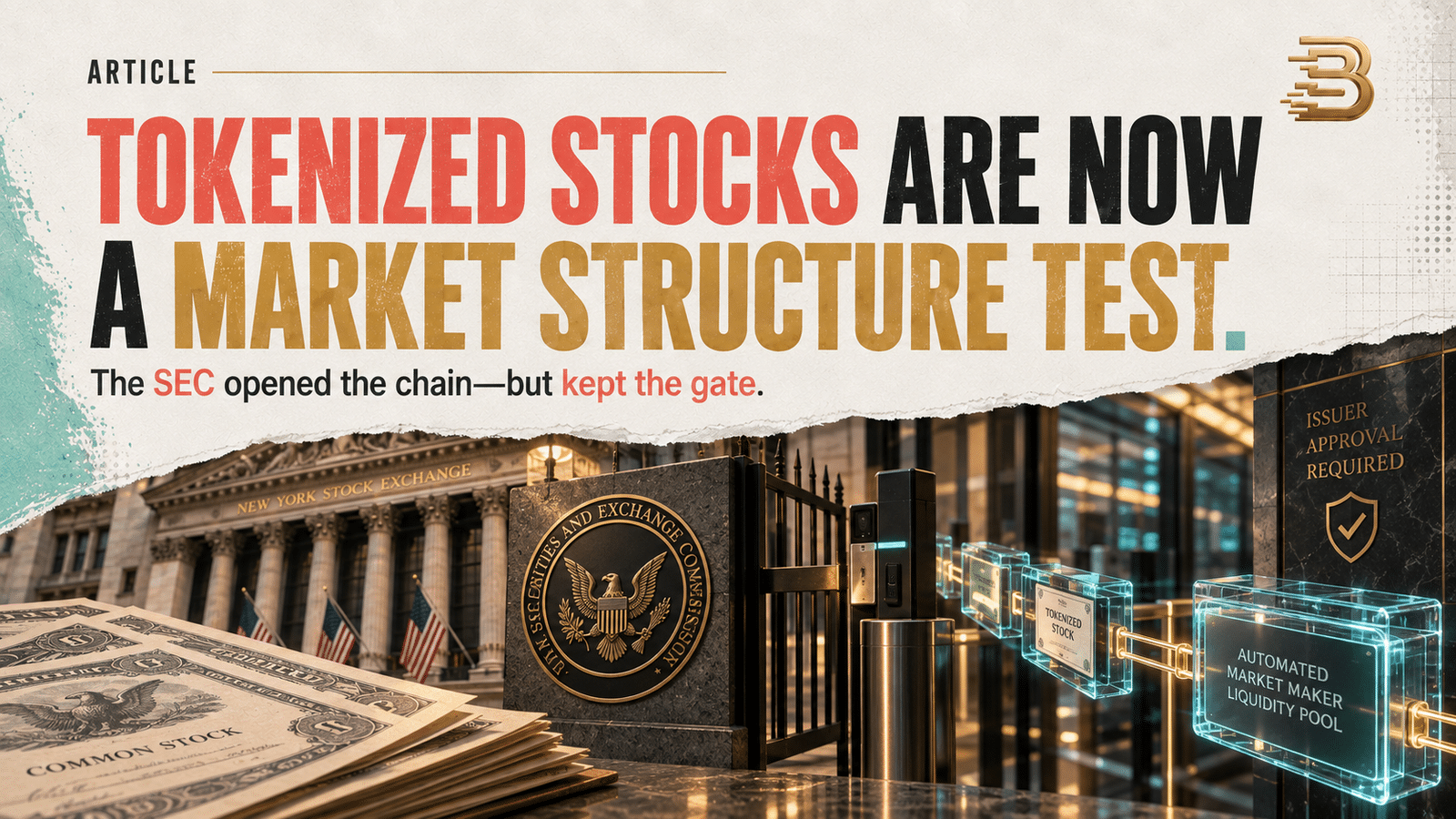
The SEC tokenized stock exemption is the most concrete U.S. test yet of whether blockchain can become market infrastructure without turning shareholder rights into an afterthought. On September 17, 2026, the Securities and Exchange Commission granted a temporary, conditional exemption that allows registered tokenized-securities venues to match trades in tokenized National Market System stocks through permissioned automated market maker pools. That sounds like a crypto milestone. It is also a reminder that the hardest part of putting equities onchain is not creating a token. It is preserving ownership, price discovery, issuer control, market integrity and legal finality when a continuously operating network meets a market built around regulated intermediaries and defined trading hours.
The order is narrower than the language of an onchain revolution, but more consequential than a technology pilot. The SEC’s announcement permits eligible tokenized securities venues, or TSVs, to rely on relief from the Exchange Act definition of an exchange while operating under detailed conditions. Covered liquidity providers can also receive limited dealer relief when supplying capital to the approved pools. The framework expires five years after publication unless a durable rule replaces it. Antifraud and antimanipulation law still applies. Access must remain permissioned, the tokens must represent real NMS shares with the same economic and governance rights, and issuers can object to unaffiliated tokenization.
This is not permissionless finance swallowing Wall Street. It is regulated market structure borrowing a blockchain settlement and execution layer. That distinction will determine who can build, which business models survive, and whether the exemption produces deeper markets or merely another set of thin wrappers around the same securities.
What the SEC actually opened
The exemption creates a supervised route for trading tokenized U.S. stocks through permissioned automated market maker pools on public, permissionless distributed ledgers. A public chain can provide a common execution record and auditable smart contracts. Permissioned access, however, means only verified participants can interact with the venue. The result is a hybrid: open infrastructure underneath, regulated gates at the edge.
The conditions are the substance. Tokenized shares must carry the same rights and privileges as their conventional equivalents, including dividends and voting rights. Synthetic tokens that merely track a stock’s price are outside the framework. Smart contracts must be publicly available and auditable. A trading halt in the underlying stock must trigger a halt in the tokenized version. Venues face symbol and volume limits, operational disclosure obligations and rules concerning affiliate trading. An issuer must receive notice and can object when an unaffiliated third party proposes to tokenize its shares.
Chairman Paul Atkins described the measure as a bridge toward durable rulemaking. That description matters. A bridge is designed to carry activity while permanent legal architecture is built; it is not permission to ignore the destination. Firms now have enough runway to prove that their systems can maintain identity, ownership and market integrity. They do not have certainty that today’s exact structure will remain optimal or lawful after the five-year window.
The immediate beneficiaries are likely to be firms that already combine brokerage compliance, custody relationships, smart-contract engineering and institutional liquidity. Coinbase, Robinhood and Kraken have all explored tokenized-equity offerings, while traditional exchanges are developing their own models. The New York Stock Exchange has described plans for a platform supporting tokenized U.S. stocks and exchange-traded funds. The competitive field is therefore not crypto venues versus an inert incumbent system. It is a race among multiple regulated stacks to decide where execution, custody, clearing and shareholder servicing should sit.
A token is easy; equivalence is hard
Creating a digital object that references a stock is technically straightforward. Creating an asset that is legally, economically and operationally equivalent to the stock is much harder. A real share is not only a price. It is a bundle of claims: voting power, dividends, corporate-action treatment, information rights and a place in an ownership record. A token that loses any of those connections is a derivative-like exposure, not a clean substitute for the underlying security.
The SEC’s insistence on equal rights is therefore the central design constraint. The token layer must stay synchronized with the issuer’s capital structure. Stock splits, mergers, tender offers, dividends, spin-offs and proxy votes all require reliable processing. A smart contract can automate predefined steps, but it cannot invent authoritative corporate data or resolve every disputed entitlement. Someone still has to determine which record controls when an onchain balance conflicts with a transfer agent, custodian or clearing ledger.
This is why tokenization cannot be evaluated only by transaction speed. A fast transfer of an ambiguous claim is not progress. The useful question is whether the entire lifecycle becomes more transparent and less fragmented without weakening legal certainty. In our earlier analysis of the SEC’s delayed proposal, Block2Learn identified execution, clearing and corporate rights as three separate market rails. The new exemption connects them more clearly, but it does not collapse them into one.
Permissioned AMMs change the microstructure
An automated market maker does not behave like a conventional central limit order book. An order book matches explicit bids and offers submitted by participants. An AMM uses a pool and an algorithm to quote prices based on inventory and a reference mechanism. The design can offer continuous access and immediate composability, but it also changes who bears inventory risk, how prices respond to information and where losses accumulate when markets move abruptly.
For widely traded stocks, the primary exchange price will remain the dominant reference during regular hours. An onchain pool that deviates from that reference invites arbitrage. That can keep the token price aligned, but arbitrage is not free. It depends on capital, settlement reliability, transfer speed and the ability to hedge in the conventional market. If any leg pauses while another stays open, spreads widen and liquidity providers protect themselves by quoting worse prices or withdrawing capital.
After-hours trading makes the tension sharper. A tokenized venue may be technically capable of operating continuously, but the underlying market, corporate disclosure machinery and hedging venues do not always operate on the same schedule. A Sunday token price can reflect new information, yet there may be no deep primary market against which to hedge. The price is real in the sense that participants transact, but its informational quality depends on pool depth and the diversity of traders. Continuous trading does not guarantee continuous liquidity.
Permissioned access can improve accountability. The venue knows who participates, can screen sanctioned persons and can enforce eligibility. It may reduce the anonymous manipulation risks associated with open pools. At the same time, permissions create concentration points. If one identity provider, custodian or compliance gateway fails, a supposedly decentralized execution system can become inaccessible. The architecture distributes some functions while centralizing others.
Issuer consent restores the corporate perimeter
The issuer-objection condition is one of the exemption’s most important and least crypto-native features. A public company can resist an unaffiliated party’s attempt to tokenize its shares. That preserves the issuer’s ability to protect its ownership records, brand and corporate-action processes. It also prevents a venue from treating a company’s equity as raw material that can be repackaged without coordination.
Critics may see the veto as a barrier to competition. It could favor large issuers and established intermediaries that have the staff to evaluate tokenization proposals. It could also slow adoption when companies fear operational mistakes or reputational risk. Yet removing issuer participation would create a more serious problem: parallel representations of the same shares could diverge in rights, disclosure and servicing. Token supply might be technically controlled while the legal relationship remains uncertain.
The exemption therefore makes issuer integration a competitive advantage. Platforms that can offer clean shareholder records, reliable proxy workflows and corporate-action automation will be more valuable than platforms that merely offer a new trading interface. The winning pitch to an issuer is unlikely to be “your stock can trade on a blockchain.” It will be “your investors can receive the same rights with faster reconciliation, broader access and auditable processing.”
The market does not stop at the smart contract
Public smart contracts improve inspectability. Participants can examine the logic governing pool behavior, token transfers and permissions. Auditable code can reduce hidden operational rules. But transparency is not the same as safety. Most users will not read bytecode, and even sophisticated reviewers can miss interactions among contracts, upgrade keys and offchain services. A contract can execute exactly as written while producing an outcome regulators, issuers or investors did not expect.
Governance is therefore part of the product. Who can upgrade a contract? How quickly can a venue respond to an exploit? Can an administrator freeze transfers without freezing legitimate owners? Is the emergency key held by one firm, a committee or a distributed signing arrangement? Does a code change require notice? The SEC’s demand for public and auditable contracts makes these questions easier to ask, but the venue must still supply credible answers.
Trading halts illustrate the link between code and institutional authority. The tokenized share must halt when its conventional counterpart halts on the primary exchange. That means the blockchain system needs a trusted, timely signal about an external event. If the signal is delayed, the token may trade on stale assumptions. If it is wrong, legitimate trading may stop. The oracle or control channel delivering the halt becomes critical infrastructure, even though it is not the visible token.
Settlement also remains layered. The SEC has already used temporary registrations to explore modernization, including a temporary clearing agency registration for Paxos. Such measures show that execution and post-trade processing cannot be reformed independently. A token trade may settle instantly between wallets, but a regulated system must still reconcile the movement with custody, capital, customer protection and the authoritative record of ownership.
Where the economic gains could appear
The strongest case for tokenized equities is not that a stock can be represented by a token. The economic case rests on reducing duplicated reconciliation. Today, brokers, clearing firms, custodians, transfer agents and issuers maintain overlapping records. Differences are resolved through messages, batch processes and operational controls. A shared ledger could give multiple parties a synchronized view of transactions and entitlements.
Atomic settlement could also reduce principal risk by linking delivery and payment. If cash and securities move in one coordinated transaction, neither side is left waiting after transferring its asset. That benefit is familiar from tokenized credit and bond experiments. Our analysis of Figure and Kiavi’s tokenized credit structure showed that the useful innovation lies in connecting origination, ownership and liquidity rather than decorating a loan with a blockchain label. The same test applies to stocks.
Shorter settlement can release collateral, but it can also increase the need for prefunding. In a conventional settlement cycle, firms have time to source cash and securities. Near-instant settlement demands that assets are ready at execution. Large participants may value lower counterparty exposure; smaller intermediaries may struggle with intraday liquidity. The system can remove one form of credit while making liquidity management more demanding.
Fractional access is another potential benefit. Token units can be divided precisely, enabling smaller transactions and tailored portfolio construction. Yet fractionalization is already available at many brokers through internal systems. The blockchain version adds value only if fractions can move across compatible venues and custodians while retaining rights. Otherwise, the token is another closed database entry with additional technical risk.
Cross-border access may widen the investor base, subject to securities law, sanctions and local eligibility rules. A common network could simplify distribution, but regulation remains jurisdictional. Public infrastructure cannot erase rules governing who may buy a security or how it must be marketed. The chain reduces distance; it does not abolish borders.
What the five-year limit changes
A five-year window is long enough to attract serious capital and short enough to shape every investment decision. Venues can build production systems, develop liquidity and collect evidence. They must also plan for a rule change, a migration or the expiration of relief. That creates regulatory sunset risk alongside market and technology risk.
The order’s limits on symbols and volumes make the exemption a controlled experiment. Regulators can observe how tokenized pools behave during volatility, corporate actions and operational failures without moving the entire equity market at once. Firms that treat the period as a data-gathering exercise will be better positioned than firms that optimize solely for headline trading volume.
The SEC also requested public comment, giving market participants a route to influence permanent rules. Evidence will matter more than slogans. A venue that can show tighter spreads, accurate rights processing, resilient halts and lower reconciliation costs has a case for expansion. A venue that offers only speculative weekend trading will have a weaker argument.
For investors, the sunset means that token portability should never be assumed. A token may need to migrate to a new contract, convert into conventional shares or move to another regulated venue. The documentation must explain the exit path. A five-year authorization is not a five-year guarantee that every platform survives.
The competitive map
The exemption creates four overlapping contests. First, crypto-native exchanges will compete to add regulated securities without losing the user experience that made digital-asset markets attractive. Second, brokers will try to extend familiar customer relationships into continuous tokenized trading. Third, traditional exchanges and market utilities will integrate blockchain while defending their central roles. Fourth, infrastructure specialists will provide custody, identity, transfer-agent, compliance and smart-contract services to all three groups.
Scale alone will not decide the winner. Liquidity begets liquidity, but tokenized shares require issuer cooperation and reliable post-trade servicing. A platform with millions of crypto users may still lack the corporate-action stack an issuer demands. A traditional exchange may have deep relationships but move slowly or keep the token inside a closed network. Infrastructure providers can win without owning the customer interface if they become the trusted connective tissue.
The failed CLARITY Act vote highlights why agency-level action matters. Congress has struggled to assemble durable majorities around comprehensive digital-asset market structure. The SEC exemption advances a narrower experiment under existing authority. That can produce evidence quickly, but it also concentrates policy in a temporary administrative instrument. The program’s durability will depend on rulemaking, judicial resilience and eventual legislative support.
How the new model differs
| Feature | Conventional stock venue | Permissioned tokenized-stock AMM | Key unresolved question |
|---|---|---|---|
| Price formation | Central limit order book | Pool algorithm plus arbitrage | Can spreads remain efficient outside primary hours? |
| Access | Broker-mediated and regulated | Wallet-based but identity-gated | Will compliance gateways remain interoperable? |
| Settlement | Clearing and custody cycle | Potentially atomic onchain transfer | Which record is legally authoritative? |
| Corporate rights | Established transfer-agent workflows | Must match the underlying share | Can votes, dividends and actions stay synchronized? |
| Trading hours | Defined sessions with limited extended hours | Potential continuous operation | Who provides deep hedging liquidity overnight? |
| System governance | Exchange rules and regulated operators | Public code plus permission and upgrade controls | Who can pause or change the contracts? |
The table shows why “onchain” is not a single design decision. Every efficiency claim has a corresponding governance question. Atomic settlement can reduce counterparty exposure but increase prefunding needs. Public code can increase transparency but expand the attack surface. Continuous trading can improve access but fragment liquidity. Issuer consent can preserve rights but slow permissionless competition.
Three scenarios for the experiment
1. Infrastructure convergence
In the strongest scenario, crypto venues, exchanges and market utilities converge on interoperable identity, custody and token standards. Issuers authorize representations that can move across compliant platforms. Liquidity providers connect onchain pools to deep conventional markets. Corporate actions flow through common data interfaces. Investors gain longer access, faster settlement and portable ownership without losing rights.
This scenario would validate the blockchain as a shared coordination layer. It resembles the logic behind India’s tokenized-bond tests, where the important question was whether instant settlement could improve the full transaction chain, not whether a digital certificate could be issued. Success would likely lead to permanent SEC rules and broader symbol and volume limits.
2. Regulated silos
In the middle scenario, several large firms build separate token ecosystems. Each works reliably, but assets and identities do not move easily between them. Investors receive extended trading and faster internal settlement, yet liquidity fragments across pools. Issuers choose one or two partners. The system becomes more digital but not materially more open.
This outcome is plausible because compliance and customer protection encourage controlled environments. The public chain would provide an audit trail, but economic activity would remain concentrated behind proprietary interfaces. The industry could still reduce reconciliation costs, although the gains would be smaller than advocates expect.
3. Liquidity and governance failure
In the weak scenario, tokenized pools attract speculative volume but insufficient durable liquidity. Weekend prices diverge, smart-contract incidents erode trust and corporate-action errors create disputes. Issuers exercise their objections. Regulators keep the limits tight or allow the exemption to expire without a broad successor.
That would not prove that distributed ledgers are useless. It would show that execution innovation cannot outrun ownership and governance. The market could still adopt blockchain for internal settlement or reconciliation while rejecting continuous token trading as a retail product.
What investors should monitor
Investors should begin with legal identity. Does the token represent the actual NMS stock with the same rights, or merely an exposure to its price? The exemption excludes synthetic substitutes, but product labels can still be confusing. Documentation should identify the issuer relationship, custodian, transfer process and treatment of corporate actions.
Next comes liquidity quality. Trading volume alone is insufficient. Useful metrics include bid-ask spread, pool depth at multiple price levels, slippage on realistic orders and the speed with which the token price reconnects to the primary market. A pool can advertise continuous trading while offering poor execution when investors most need it.
Operational controls matter as much as the user interface. Investors should know how trading halts propagate, who can pause transfers, how contract upgrades occur and what happens if the venue fails. Public smart contracts are valuable only when the surrounding keys, oracles and recovery procedures are disclosed.
Finally, follow the evidence submitted during the comment and rulemaking process. The exemption is designed to teach regulators and markets. Symbol expansions, issuer participation, institutional market-making and clearing integration will reveal more than promotional announcements. The decisive milestone is not the first tokenized trade. It is the first period of stress that the structure survives without sacrificing ownership certainty or market fairness.
Block2Learn assessment
The SEC tokenized stock exemption is a meaningful opening because it defines a path from experimental tokens to regulated market structure. It is deliberately not a blank check. Permissioned access, real-share equivalence, issuer objection, synchronized halts, public contracts and volume limits create a system in which blockchain capabilities operate inside a legal perimeter.
That design will frustrate purists on both sides. Crypto advocates may dislike issuer vetoes and identity gates. Traditional market participants may question whether AMM pools improve a highly liquid equity market. The hybrid is valuable precisely because it forces those objections into a measurable experiment. Over five years, the market can test whether continuous execution, auditable code and atomic settlement produce benefits large enough to justify new operational risks.
The central lesson is that tokenization moves competition down the stack. The visible token is the least defensible layer. Durable value will accrue to systems that connect execution to legal ownership, corporate rights, liquidity and settlement. A platform that solves only the wallet experience can be copied. A platform that makes the full lifecycle more reliable can become infrastructure.
For readers building their foundation, the Block2Learn Learning Path explains how markets, blockchain networks and digital assets fit together before the details of market microstructure are added. The SEC has opened the chain, but it has kept the gate. Whether that combination becomes a new market or merely a new interface now depends on execution.
Learn continuously. Build deliberately.
This article is provided solely for informational and educational purposes and does not constitute financial or investment advice, a recommendation, or an offer or solicitation to buy or sell any financial instrument or digital asset. See our Financial Disclaimer.
This article was generated with the support of AI and reviewed by the Editorial Team. For more information, see our Terms of Service.